In 2025, there were 303,213 breakdowns recorded on England’s motorway network, representing a 7% increase from the previous year. If you have ever experienced a car breakdown on motorway London routes like the M25, you know the immediate surge of anxiety that comes with high-speed traffic rushing past your door. It’s perfectly natural to feel overwhelmed or confused about current smart motorway regulations, especially when your primary focus is simply keeping your passengers out of harm’s way.
Whether you are facing a flat tyre on a traditional hard shoulder or a sudden engine failure in an all-lane running section, we are here to help you regain control of the situation. This 2026 safety checklist provides a clear, expert-led protocol to help you navigate the legal duties and safety requirements of the capital’s busiest roads. We will walk you through the essential steps to secure your vehicle, how to use emergency refuge areas, and how to access fast professional assistance so you can get moving again with total peace of mind.
- The vital actions to take during the first sixty seconds of a car breakdown on motorway London roads to ensure you and your passengers stay protected.
- Clear guidance on how to identify and reach orange emergency areas on smart motorways, whether you are on an all-lane running section or a dynamic hard shoulder.
- Essential protocols for maintaining visibility and staying calm whilst waiting for help, with specific advice for supporting children and elderly passengers.
- A breakdown of London’s unique road challenges, from the M25’s variable speed limits to the strict stopping rules on Red Route A-roads.
- How to arrange rapid, professional recovery through a team that prioritises your safety and provides a clear path to resolution.
Immediate Actions: The First 60 Seconds of a Motorway Breakdown
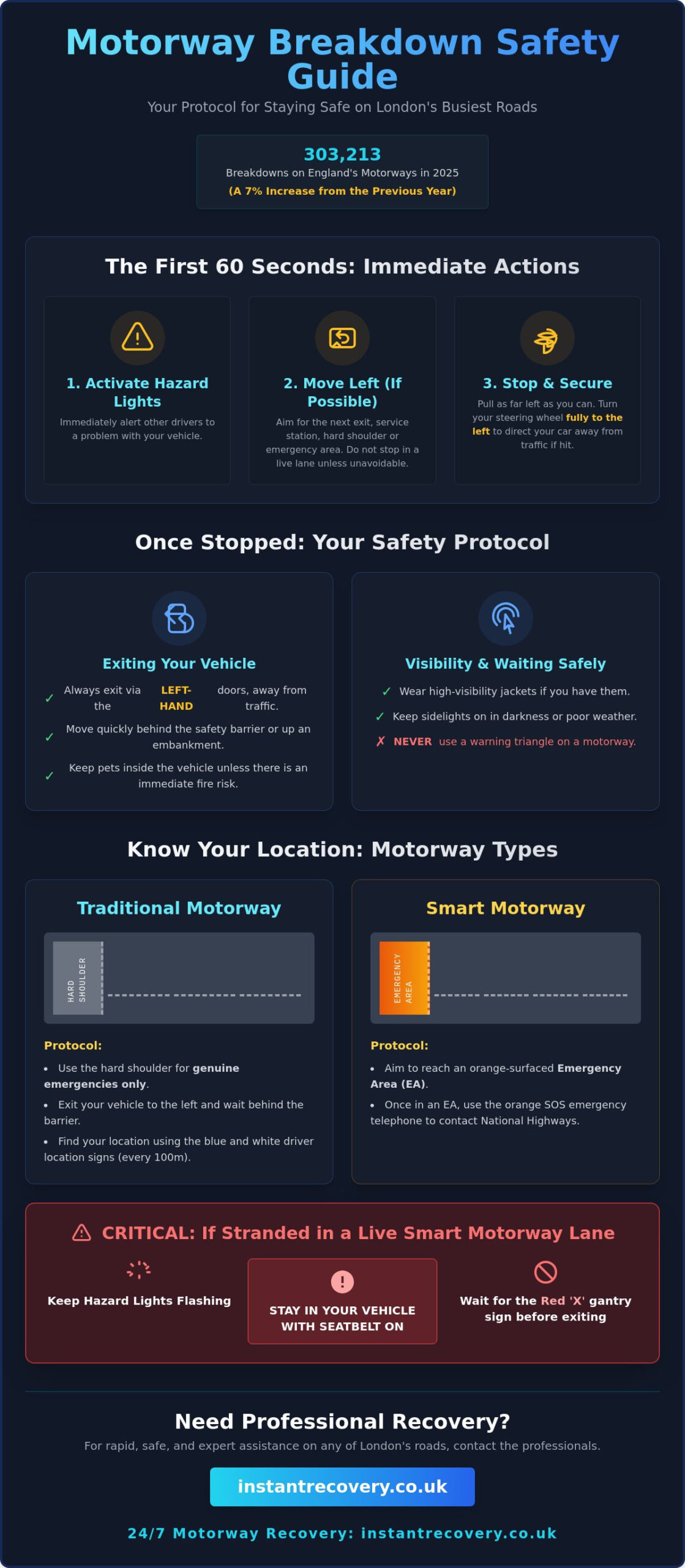
The moments following a mechanical failure are often the most critical for your safety. If you experience a car breakdown on motorway London networks, your priority is to remain calm and act with speed. As soon as you realise your vehicle is losing power or handling strangely, switch on your hazard warning lights. This simple action provides an immediate visual cue to following drivers, allowing them to adjust their speed and give you the space you need to manoeuvre.
If your vehicle still has momentum, don’t stop immediately in a live lane. Aim to reach the next exit or a nearby service station where you can park in a secure environment. If that isn’t possible, steer your car as far to the left as you can, ideally onto the hard shoulder or into an emergency area. Whether you are on a traditional motorway or understanding smart motorways where the hard shoulder may be used as a live lane, positioning is everything. Once stopped, turn your steering wheel fully to the left. This ensures that if another vehicle strikes yours from behind, your car will be pushed into the barrier or verge rather than back into the flow of high-speed traffic.
Safely Exiting the Vehicle
Once the car is stationary, you must exit the vehicle with extreme caution. Always use the doors on the left-hand side, even if it means climbing over the centre console. Stepping out into a live lane is incredibly dangerous and should be avoided at all costs. Ensure all passengers move quickly and stay behind the crash barrier or, if available, move up a nearby embankment. If you are travelling with pets, it’s safest to leave them inside the vehicle unless there is an immediate threat of fire, as a panicked animal running onto the motorway can cause a secondary collision.
Initial Communication
Visibility remains your best protection whilst you wait for assistance. If it’s dark or the weather is poor, keep your sidelights on to supplement your hazards. To help recovery teams find you quickly, identify your exact location. Look for the small blue and white driver location signs placed at 100-metre intervals along the verge, or use a smartphone map to pin your coordinates. Your goal is to reach a “Place of Relative Safety,” which the Highway Code defines as a location where you are protected from traffic, such as behind a crash barrier or on an embankment well away from the road. Staying focused on these steps ensures you remain protected until professional help arrives.
Traditional Hard Shoulder Protocol
If you are on a section with a permanent hard shoulder, only use it for genuine emergencies. It is never a safe place to stop for a rest or to use your phone. Following National Highways official breakdown advice, you must never attempt to place a warning triangle on a motorway. The risk of being struck by high-speed traffic whilst walking to place the triangle is far too high. Instead, focus on keeping your distance from the road; stand well back from the carriageway, ideally behind the safety barrier, and wait for professional help to arrive.
Smart Motorway Emergency Areas
When there is no hard shoulder, look for Emergency Areas (EAs). These are spaced at regular intervals and are clearly marked with orange SOS signs and a bright orange surface. If you can’t reach an EA and find yourself stranded in a live lane, stay in your vehicle with your seatbelt on and your hazard lights flashing. Wait for the “Red X” to appear on the overhead gantries before attempting to exit, as this signals that the lane has been closed to following traffic. Once you have reached an EA, use the emergency roadside telephone to speak directly with National Highways, as they can coordinate lane closures and alert the police. If you find yourself in a vulnerable position, a quick call for vehicle recovery can ensure a professional team is dispatched to your exact location immediately.
Essential Visibility and Safety whilst Waiting for Recovery
Once you have safely exited your vehicle, your focus shifts to maintaining high visibility and ensuring the emotional well-being of everyone involved. If you have high-visibility jackets or waistcoats stored in the car, put them on before you step out. It’s a simple step that makes a massive difference to drivers approaching at 70mph. Whether you are dealing with a car breakdown on motorway London routes during a clear day or in the middle of a torrential downpour, you must stay behind the safety barrier at all times. It might be tempting to seek shelter inside the car if it starts to rain, but the risk of a stationary vehicle being hit is far too high. Stand as far up the embankment or away from the road as possible, even if the ground is uneven or wet.
Passenger Safety and Behaviour
Keeping a group together on a busy roadside requires a calm, methodical approach. Reassure children and the elderly by explaining that help is on the way and that they are in the safest possible spot. Remind everyone to face oncoming traffic at all times. This positioning allows you to see any potential hazards and react quickly if a vehicle drifts towards the shoulder. Above all, ensure no one attempts any “DIY” repairs. The physical force of air pushed by a passing heavy goods vehicle can be enough to pull a person towards the traffic. Changing a tyre or checking an engine on the side of a motorway is never worth the risk; your life is far more valuable than the cost of a recovery service.
Managing Your Smartphone
Your phone is your lifeline, so treat the battery as a precious resource. Avoid using social media, games, or non-essential apps whilst you wait. Instead, use a location-sharing tool like what3words to provide a precise three-metre square location to the professional vehicle recovery London team. This level of accuracy helps our drivers reach you much faster, especially on complex stretches of the M25. Once you have made the initial call and shared your details, keep the line clear. We may need to call you back with an updated arrival time or specific safety instructions. If you have a portable power bank, keep it connected to ensure you don’t lose contact before we arrive.
Navigating London’s Specific Road Challenges: M25 and A-Roads
London’s road network presents a unique set of challenges that can turn a simple mechanical failure into a complex logistical puzzle. If you experience a car breakdown on motorway London routes, you aren’t just dealing with high-speed traffic; you are navigating one of the most monitored and congested environments in the world. The M25 remains a significant hotspot for motorists, with 2024 data showing it has the highest rate of incidents in England at 238 breakdowns per mile. Navigating this orbital route requires constant attention to the overhead gantries, as variable speed limits can drop from 70mph to 20mph in seconds to manage heavy congestion or accidents ahead.
While motorways like the M25 and M11 are daunting, London’s A-roads introduce their own specific rules, such as Red Routes. These roads, marked by single or double red lines, strictly prohibit stopping at any time to ensure the capital’s bus and freight movements remain fluid. If your car fails on a Red Route or near high-risk areas like the North Circular (A406) or the approach to the Blackwall Tunnel, the pressure to move the vehicle is immense. We understand this urgency and provide the calm, expert guidance needed to clear these vital arteries safely and legally.
ULEZ and Congestion Charge Considerations
If you are driving an older vehicle, the Ultra Low Emission Zone (ULEZ) is a factor you cannot ignore. With the average car age in the UK reaching 9.4 years in 2023, many motorists find themselves driving non-compliant vehicles through these zones. When a breakdown occurs, you may worry about how this affects your recovery options. It is important to verify that your recovery provider uses ULEZ-compliant trucks to avoid additional fines. While emergency services and recovery vehicles are often granted certain leeway in a crisis, having a clear understanding of car recovery cost London helps you manage the financial side of an already stressful day.
London’s Major Orbital Routes
Elevated sections of the A40 or the M4 present some of the most dangerous breakdown scenarios in the city. These stretches often lack a traditional hard shoulder and have limited space between the live lane and the concrete barrier. If you lose power here, try to keep the car moving until you find a wider section or a designated slip road. In the busy junctions of East London and Essex, traffic patterns are particularly unpredictable on Fridays, which accounted for 16% of all motorway breakdowns in 2025. Drivers in the Barking and Dagenham area who regularly use the A13 or the North Circular are especially vulnerable to these conditions, and having access to trusted vehicle recovery Barking specialists can make all the difference when an engine cuts out during the evening commute. For immediate assistance from a team that understands these local complexities, contact us for professional vehicle recovery today.
Arranging Professional Recovery with Instant Recovery
When you are stranded on the hard shoulder or in a busy emergency area, the most important thing you can do is secure professional assistance. We understand that a car breakdown on motorway London routes is more than just a mechanical failure; it is a high-stress event that requires a calm, expert response. Our team at Instant Recovery provides 24/7 rapid dispatch across London and Essex, ensuring you aren’t left waiting in a vulnerable position for longer than necessary. By choosing a service that specialises in the capital’s unique road network, you gain the peace of mind that help is coming from a team that knows exactly how to reach you.
To help us get you moving again, please provide our team with your vehicle’s make and model, along with your precise location. Whether you are using a what3words address or describing nearby landmarks, this accuracy is vital for our drivers. We also ask that you describe the symptoms of the breakdown, such as whether the engine cut out suddenly or if you have a flat tyre. This information allows us to prepare the right equipment before we even leave the depot. Once you have made the call, stay in your safe place behind the barrier and wait for our liveried recovery vehicle to arrive. We will keep you updated on our progress so you never feel alone in the process.
Why Choose a Local London Specialist?
National breakdown clubs often struggle with the sheer density of the capital’s traffic, which can lead to frustratingly long wait times. Our drivers are local experts who understand London’s complex shortcuts and congestion patterns, allowing us to bypass the worst of the M25 or North Circular traffic. When you call us, you won’t be treated as just another number in a national database. We prioritise honesty and respect, providing a transparent, flat-rate estimate before we arrive on-site. This integrity-driven approach ensures there are no hidden surprises during an already difficult day.
What to Expect When We Arrive
Our technician’s first priority upon arrival is to perform a thorough safety assessment of the scene. We ensure the recovery environment is secure before we begin any work on your vehicle. Whether you simply need a jumpstart to get back on your way or a full vehicle recovery to a local garage, we handle your property with personal care. If you are curious about the specialist equipment and engineering that goes into safely lifting and transporting your car, our guide to the anatomy of a modern recovery vehicle and how towing works in 2026 explains exactly what arrives at your side. If the car cannot be fixed at the roadside, we can safely transport both you and your vehicle to your home address or a trusted repair centre. Our goal is to provide a methodical and supportive path to resolution, turning a motorway crisis into a manageable situation; once you’re safely home, you can even check out UK Skydiving to plan a much more enjoyable adventure.
Staying Safe and Moving Forward on London’s Roads
Managing a car breakdown on motorway London routes requires a combination of quick thinking and a clear understanding of modern road layouts. By prioritising the first sixty seconds, such as activating your hazards and moving to a place of relative safety behind the crash barrier, you significantly reduce the risks associated with high-speed traffic. Whether you are navigating the complex stretches of the M25 or a busy London A-road, staying calm and visible is your best defence until professional help arrives.
We are here to ensure you don’t have to face these high-stress situations alone. Our team provides a 24/7 rapid response across London and Essex, using professional, liveried recovery vehicles to reach you quickly. We believe in honesty and respect, which is why we offer transparent, fair pricing with no hidden fees to worry about. If you find yourself in need of expert support, you can get 24/7 emergency assistance now from Instant Recovery. No matter the time or location, we are ready to help you get back to safety with the care and efficiency you deserve.
Frequently Asked Questions
Can I stay in my car if I break down on the motorway?
No, you should always exit your vehicle if you have successfully reached the hard shoulder or a designated emergency area. Leaving the car via the left-hand doors and waiting well behind the safety barrier is the safest course of action. The only exception is if you are stranded in a live lane and cannot exit the vehicle safely, in which case you should keep your seatbelt on and call the emergency services immediately.
What should I do if I break down in a live lane with no hard shoulder?
If you find yourself stationary in a live lane, keep your seatbelt fastened and switch on your hazard lights to alert following drivers. Call 999 as soon as possible so that National Highways can close the lane using the Red X symbol on overhead gantries. You should only attempt to exit the vehicle if you are certain you can reach a place of relative safety without crossing live traffic lanes.
Is it legal to use a warning triangle on a London motorway?
No, you must never attempt to use a warning triangle on a motorway or a high-speed dual carriageway. The Highway Code advises against this because the risk of being struck by traffic whilst walking to place or retrieve the triangle is far too high. Your priority should be getting yourself and your passengers behind the crash barrier as quickly as possible.
Will my car be towed if I break down in the ULEZ zone?
Yes, we can provide professional recovery within the Ultra Low Emission Zone using our fleet of compliant vehicles. If you experience a car breakdown on motorway London stretches that fall within the zone, we ensure your vehicle is transported safely to your chosen destination. Our team is fully equipped to handle the logistics of the zone so you don’t have to worry about additional compliance issues during the recovery.
How do I find my exact location on the M25 for recovery?
You can identify your precise position by looking for the small blue and white driver location signs found at 100-metre intervals along the verge. These signs provide the motorway number, the direction of travel, and a unique location code. Alternatively, using a smartphone to share a what3words address or a GPS pin allows our drivers to find you with pinpoint accuracy, even on the busiest sections of the orbital route.
What happens if I break down in a London tunnel like the Blackwall?
If your vehicle fails inside a tunnel, switch on your hazards and use the emergency roadside telephone to alert the tunnel control room. Most London tunnels are monitored by CCTV and have dedicated recovery protocols to clear obstructions quickly and prevent tailbacks. Once your vehicle has been moved to a safe location outside the tunnel environment, we can provide onward recovery to your home or a local garage.
Do I have to pay the Congestion Charge if my car is being recovered?
You may still be liable for the charge if your vehicle enters the charging zone during operational hours, even if it is on the back of a recovery truck. However, our drivers are experienced in navigating the capital and can often suggest routes that avoid the zone if your destination allows. We prioritise your safety and will always choose the most secure and efficient path to get you home.
Can Instant Recovery help if I have a flat tyre on the motorway?
Yes, we provide an Emergency Tyre Change service specifically for motorists who cannot safely change a wheel at the roadside. Attempting to fix a puncture on a motorway is extremely dangerous due to the proximity of high-speed traffic and the wind blast from passing lorries. We will arrive in a liveried vehicle to secure the scene and perform the change quickly so you can get moving again.