Imagine standing beside your car on a busy, narrow London street whilst traffic squeezes past; the only thing more stressful than the breakdown itself is the worry that a recovery vehicle might cause more damage during the lift. We understand that your car is likely your most valuable tool, and the thought of it being winched or towed can feel incredibly daunting. It is completely natural to feel anxious about whether the equipment is right for your specific model, especially with the unique requirements of modern electric vehicles or the tight corners of the city.
You deserve to feel confident that your vehicle is in safe hands. This guide will help you discover the advanced engineering, safety features, and specialist equipment that make the modern recovery vehicle the backbone of London roadside assistance in 2026. We will look at the different types of trucks available, from low-clearance specialists for sports cars to flatbeds designed for EVs, so you know exactly which truck is right for your car. You will also learn about the rigorous safety protocols that ensure every journey is handled with the highest level of care and integrity.
Key Takeaways
- Understand why a purpose-built recovery vehicle is a precision tool rather than just a transporter, ensuring your car receives the highest standard of care during transit.
- Discover how slide-bed technology provides a level, damage-free platform for your vehicle, whether you are driving a family saloon or a luxury car.
- Learn about the shift to synthetic winching ropes and advanced hydraulics, which offer a safer and more stable recovery process than older mechanical methods.
- Recognise the specialist requirements for electric vehicles and low-clearance models to avoid common pitfalls like motor damage or bodywork scratches.
- Identify the key signs of a professional fleet, from vehicle cleanliness to maintenance standards, so you can choose a reliable recovery partner with confidence.
What is a Recovery Vehicle? Defining the Modern Lifeline
Stranded motorists often use the terms “tow truck” and recovery vehicle interchangeably, but in the professional world of roadside assistance, there is a significant distinction. A modern recovery vehicle is not merely a truck with a hook; it is a purpose-built commercial chassis engineered specifically for the safe transport of casualty vehicles. Whether you have experienced a sudden mechanical failure or a minor collision, this machine serves as a mobile sanctuary for your car, protecting it from further harm whilst clearing the path for other road users.
The evolution of these vehicles reflects the increasing complexity of our cars. Decades ago, a simple rope or a basic crane was enough to drag a broken-down vehicle to the nearest garage. Today, we rely on hydraulic precision machines. A professional Vehicle recovery operation is far more than a simple tow; it is a coordinated effort to manage a roadside crisis. In a city as busy as London, where even a ten-minute blockage can cause miles of tailbacks, these vehicles are vital for maintaining traffic flow and ensuring the safety of everyone on the road.
The Primary Purpose of Roadside Recovery
The most immediate role of these specialist machines is the safe extraction of non-runners from hazardous positions. If your car has stopped in a live lane or a precarious spot on a narrow street, the priority is to move it quickly without causing secondary accidents. These vehicles often act as a mobile workshop environment. They carry the tools necessary for minor roadside fixes, such as an emergency tyre change or a jumpstart, which can sometimes get you back on your way without a tow. When a car cannot be driven, the recovery vehicle provides a “total lift,” ensuring all wheels are off the ground to protect the drivetrain and gearbox from damage.
Recovery vs. Transport: Understanding the Difference
Emergency recovery requires a completely different set of equipment and skills compared to scheduled car logistics. Whilst transport companies focus on moving cars from one dealership to another, recovery teams deal with the unpredictable. This requires rapid deployment capabilities and high-intensity safety lighting to protect the scene on London motorways or busy junctions. The equipment must be versatile enough to handle everything from a locked-wheel recovery to a vehicle with a lost key. A recovery vehicle is a specialised mobile unit equipped for both mechanical intervention and secure transport.
The Different Types of Recovery Vehicles and Their Roles
When you call for help, the dispatcher’s questions about your car’s make, model, and location aren’t just for paperwork. They’re determining which specific recovery vehicle is best suited to protect your property. Choosing the wrong equipment could lead to costly transmission damage or bodywork scuffs, which is why a professional fleet is categorised by the weight of the casualty vehicle and the method of lift required. Different types of wrecker trucks serve distinct purposes, from light-duty units for city runarounds to massive heavy recovery machines designed for lorries and commercial vans.
Flatbed Recovery: The Safest Method for Modern Cars
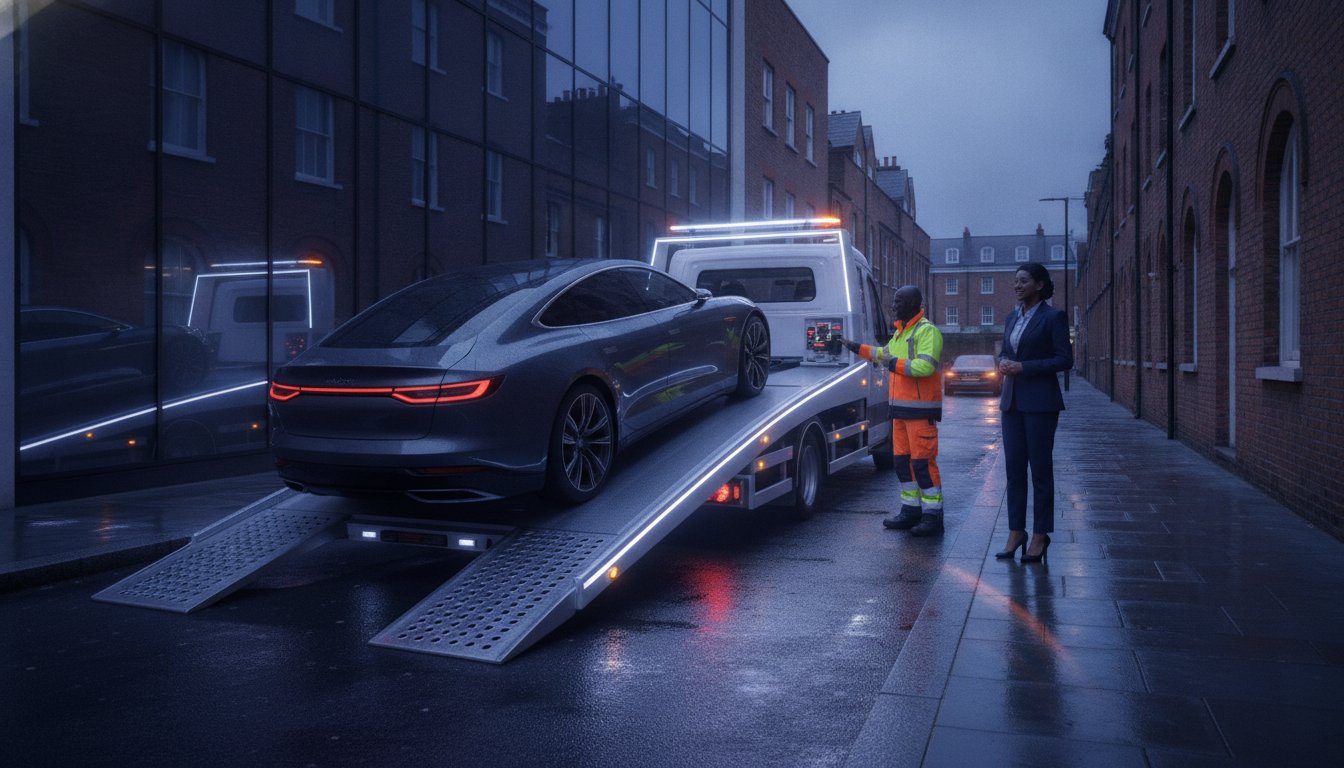
The ‘Slide-Bed’ or flatbed is widely considered the gold standard for damage-free transport. It features a hydraulic platform that slides back and tilts to the ground, creating a shallow loading angle. This is particularly vital for cars with low ground clearance or those with automatic gearboxes and 4WD systems that cannot be towed with wheels on the road. If your car is a non-runner, a powerful winch safely guides it onto the platform, ensuring no strain is placed on the engine or transmission. This method provides total peace of mind by keeping the entire vehicle off the tarmac throughout the journey.
Spec-Lifts and Rapid Deployment Trailers
Whilst flatbeds are excellent, they are often too large for the cramped streets of East London or low-ceiling multi-storey car parks. This is where the ‘Spec-Lift’ or spectacle lift proves its worth. These versatile urban warriors use a metal cradle that fits around the tyres, lifting only one axle whilst the other wheels roll. They are incredibly quick to deploy, making them the preferred choice for clearing busy arterial roads where speed is essential for safety. If you find yourself stuck in a tight spot, our team at Instant Recovery can dispatch the perfect vehicle to reach you without delay.
For larger vehicles, such as delivery vans or HGVs, heavy units are required to manage the immense weight of commercial transport. These machines use heavy-duty booms and underlifts, ensuring that even the largest vehicles are moved with the same level of care as a family hatchback. By matching the recovery vehicle to the specific needs of your situation, we ensure that your property is handled with the integrity and professionalism you expect during a stressful time.
The Anatomy of a Modern Recovery Vehicle: Equipment & Safety
Whilst the outward appearance of a recovery vehicle may seem purely industrial, the technology beneath the surface is a marvel of precision engineering. At the heart of every truck is the Power Take-Off (PTO) system, which diverts energy from the engine to drive complex hydraulic systems. These hydraulics allow for the smooth, judder-free movement of the recovery bed or lift arm. Whether our team is operating in a quiet residential street or the middle of a rain-swept motorway, this mechanical reliability ensures that your vehicle is handled with the utmost care and stability.
Safety is our absolute priority, which is why modern fleets are equipped with high-intensity LED light bars and 360-degree work floodlights. These aren’t just for the operator’s benefit; they create a visible safety zone that protects you, your car, and other road users from oncoming traffic. By using advanced traffic management equipment, such as collapsible cones and digital warning signs, we transform a hazardous breakdown site into a controlled, professional environment where the recovery can proceed without unnecessary risk.
The Winch: Precision Control
Modern winching technology has moved far beyond the noisy, unpredictable systems of the past. We now utilise variable speed winches that allow for centimetre-perfect loading, preventing any sudden jolts that could damage your car’s frame or bumper. A significant safety advancement in 2026 is the widespread adoption of synthetic ropes over traditional steel cables. Synthetic ropes are just as strong but far safer; if a cable were to fail under tension, a steel wire can whip dangerously, whereas a synthetic rope simply drops to the ground. For vehicles stuck in awkward positions, we use snatch blocks to safely change the pull angle, ensuring a smooth extraction from even the tightest London spots.
Vehicle Securing Systems
Once your car is loaded, the method of securing it is vital for a damage-free journey. We have moved away from old-fashioned “hook and chain” methods that could bend suspension arms or scratch the chassis. Instead, we use soft-link bridles and four-point tie-downs that distribute tension evenly. Modern wheel straps ensure the vehicle is held by its “unsprung weight,” protecting the delicate suspension alignment. By securing the car by its tyres rather than its body, we allow the car’s own suspension to absorb the bumps of the road during transit, just as it was designed to do.
The Operator’s Command Centre
The cab of a 2026 recovery vehicle functions as a high-tech command centre. In-cab telemetry and GPS tracking provide us with real-time data, allowing us to give you an incredibly accurate ETA so you aren’t left wondering when help will arrive. Operators also use external control banks or remote pendants to manage the lift from a safe distance, giving them a better line of sight during the loading process. Integrated CCTV and rear-view cameras further assist in ensuring that every car is positioned perfectly on the deck, providing a level of precision that was simply impossible a decade ago.
Specialist Recovery: EVs, Low Clearance, and London Streets
Operating in London requires more than just a powerful truck; it demands a fleet that can navigate some of the tightest urban geography in the world whilst adhering to strict environmental standards. As of 2026, the daily London Congestion Charge has risen to £18, and the previous 100% discount for electric vehicles has been reduced to 25%. To remain efficient and cost-effective for our customers, a modern recovery vehicle must be either Euro 6 compliant or fully electric. This ensures we can provide support in every borough without passing on heavy environmental levies to you.
Why EVs Require Total-Lift Recovery
Electric vehicles present a specific technical challenge that traditional towing methods simply cannot handle. If an EV is towed with its drive wheels on the road, the rotating motor can generate an “induced current,” leading to catastrophic damage to the high-voltage battery or inverter. This is why we prioritise total-lift recovery for every Tesla, ID.4, or Taycan we encounter. For a deeper look at these safety protocols, you can read our electric vehicle recovery London specialist guide. Our operators undergo rigorous training to handle high-voltage systems safely, particularly after an accident where battery integrity might be compromised.
Recovering Vehicles in Tight Urban Spaces
The “London squeeze” is a reality for anyone driving through narrow mews or the historic side streets of East London. When a car has locked wheels or restricted steering in these cramped spots, we utilise specialist tools like “skates” and “go-jaks.” These devices allow us to lift each wheel individually and glide the vehicle into a position where it can be safely loaded onto the recovery vehicle. This precision prevents bumper scuffs on low-clearance sports cars, which require specialised “low-approach” ramps to ensure the loading angle is shallow enough to protect the bodywork.
Local knowledge is just as important as the equipment itself. Understanding height restrictions and the rhythm of London traffic allows our team to act as a “Caring Guardian,” managing the flow of vehicles whilst focusing on your safety. Whether you are facing a flat battery in a basement car park or a breakdown on a busy red route, we have the compact tools and the expertise to resolve the situation. Drivers stranded on routes like the A406 North Circular can rely on our dedicated car recovery Waltham Forest service for rapid, professional assistance in the area. If you are currently stranded and need professional assistance, contact our team at Instant Recovery for a rapid, damage-free solution.
Choosing a Professional Vehicle Recovery Service in London
Choosing a professional service in a city as fast-paced as London means looking beyond the first search result. You need a partner that maintains impeccable fleet standards; this includes checking for vehicle cleanliness, the age of the equipment, and documented maintenance logs. For an example of how a major recovery operator manages a large-scale fleet with these high standards, click here. A well-kept truck is a clear sign that the operator treats your property with the same level of respect they show their own tools. Reliability isn’t just a promise; it’s something that should be visible in every hydraulic lift and polished winch.
Fleet Standards and Operator Training
Technical skill is only one half of the equation. Peace of mind comes from knowing your driver holds IVR (Institute of Vehicle Recovery) certification, which is the industry benchmark for safety and competence. This certification ensures that the person handling your car understands the specific stresses placed on a chassis during a lift. There is a direct link between well-maintained equipment and the safety of your vehicle. Our team treats every car with the same care as their own favourite vehicle, ensuring that every strap is tightened correctly and every loading angle is checked twice. We don’t just move cars; we protect your investment.
Anxiety often stems from the unknown, particularly regarding the financial side of an emergency. A hallmark of a reputable firm is providing a transparent car recovery cost London before the work begins. In an era where operating costs in the capital are rising due to congestion charges and fuel prices, honesty about fees ensures there are no unpleasant surprises when you are already in a vulnerable state. Integrity-driven firms will always offer a clear breakdown of their services, from the initial call-out to the final drop-off point.
The Instant Recovery Difference
Our commitment to excellence extends across every borough, from the busy streets of Barking to the residential avenues of Stratford. Drivers who regularly commute along the A13 or through East London’s arterial roads can rely on our dedicated vehicle recovery Barking service for rapid, damage-free assistance whenever they need it most. We believe in using the right tool for every specific job, ensuring that whether you drive a compact electric city car or a large commercial van, the recovery vehicle sent to you is perfectly matched to your needs. We keep you informed throughout the entire process, using real-time updates to reduce the stress of waiting. This methodical and supportive approach is what transforms a breakdown from a crisis into a manageable hurdle.
You deserve a service that combines high-tech hardware with an empathetic, human touch. We act as your “Caring Guardian” on the road, ensuring both you and your vehicle are moved to safety with speed and professionalism. If you need professional vehicle recovery London, call our team for a free estimate today and experience a service built on honesty and care.
Moving Forward with Confidence on London’s Roads
A roadside breakdown is never planned, but understanding the precision and care behind a modern recovery vehicle can transform a high-stress situation into a manageable one. By recognising the importance of specialist equipment, such as slide-beds for electric vehicles and compact units for narrow city streets, you are better equipped to demand the high safety standards your car deserves. Professional recovery is fundamentally about protecting your property whilst ensuring the safety of everyone on the road through expertise and integrity.
Whether you are facing a mechanical failure or a sudden flat tyre, our team is here to act as your caring guardian. Need urgent assistance? Contact Instant Recovery for 24/7 professional vehicle recovery. We provide 24/7 emergency dispatch and a damage-free guarantee, all delivered with expert East London local knowledge to ensure we reach you quickly. You don’t have to face a roadside crisis alone; stay safe on the road knowing that a reliable neighbour is always ready to help you get back on track.
Frequently Asked Questions
What is the difference between a tow truck and a recovery vehicle?
A tow truck is a general term often referring to basic lifting equipment, whilst a recovery vehicle is a purpose-built precision machine designed specifically for casualty transport. Modern recovery units feature sophisticated hydraulics and total-lift capabilities that go far beyond simple towing. This distinction is vital for protecting modern vehicle components, ensuring that your car is handled with specialist care rather than being dragged behind a basic utility truck.
Can my electric car be towed by a standard recovery vehicle?
You should never tow an electric vehicle with its drive wheels on the road, as this can cause permanent damage to the motor and battery. Whilst a standard flatbed recovery vehicle is perfectly suited for the task, the operator must use a total-lift method. This ensures that the electric motors don’t rotate during transit, preserving your warranty and protecting the delicate high-voltage systems from induced current damage.
Will a recovery vehicle damage my car’s bumper or suspension?
Professional recovery operators use specialised equipment like low-approach ramps and soft-link wheel straps to prevent any damage to your car’s bodywork or suspension. By securing the vehicle by its tyres rather than the chassis, we protect the delicate alignment of your suspension components. Whether your car has low ground clearance or sensitive modern bumpers, our methodical loading process ensures it remains in the same condition as when we arrived.
Do recovery vehicles carry passengers as well as the car?
Most modern recovery trucks are equipped with a crew cab that allows them to safely transport the driver and up to five passengers, depending on the specific truck size. We understand that being stranded is a stressful experience, so we prioritise your comfort and safety alongside your vehicle’s transport. If you have a larger group, we can coordinate additional support to ensure everyone is moved away from the roadside as quickly as possible.
What happens if my car is stuck in a multi-storey car park?
If your vehicle is trapped in a low-ceiling environment, we dispatch a specialist spec-lift or a low-profile unit designed for height-restricted areas. These compact machines can navigate tight corners and low beams that would block a standard flatbed. We also use wheel skates to glide your car into an accessible position, ensuring a smooth extraction without risking any contact with the car park’s structure or other parked vehicles.
Are all recovery vehicles allowed in the London ULEZ zone?
Professional fleets operating in the capital must be Euro 6 compliant or electric to enter the Ultra Low Emission Zone without penalty. We ensure our vehicles meet these strict environmental standards, allowing us to reach you anywhere in London without passing on additional daily charges. This commitment to modern, clean equipment reflects our broader philosophy of providing a reliable and socially responsible service to our local London community.
How much weight can a standard recovery vehicle carry?
A standard light-duty flatbed can typically carry vehicles weighing up to 3.5 tonnes, which covers almost all passenger cars and small vans. If you are driving a larger commercial vehicle or a heavy 4×4, we dispatch medium or heavy-duty units specifically engineered for higher payloads. By providing the dispatcher with your vehicle’s make and model, we ensure the correct equipment is sent to handle the weight safely and securely.
Can a recovery vehicle tow a car with a locked steering column?
Yes, we can safely recover vehicles with locked steering or missing keys by using wheel skates or a total-lift flatbed. These tools allow us to lift the car off the ground entirely or glide it onto the truck without needing to turn the wheels. It’s a common scenario that we handle with precision, ensuring that your vehicle is moved without causing any strain on the steering mechanism or tyres.