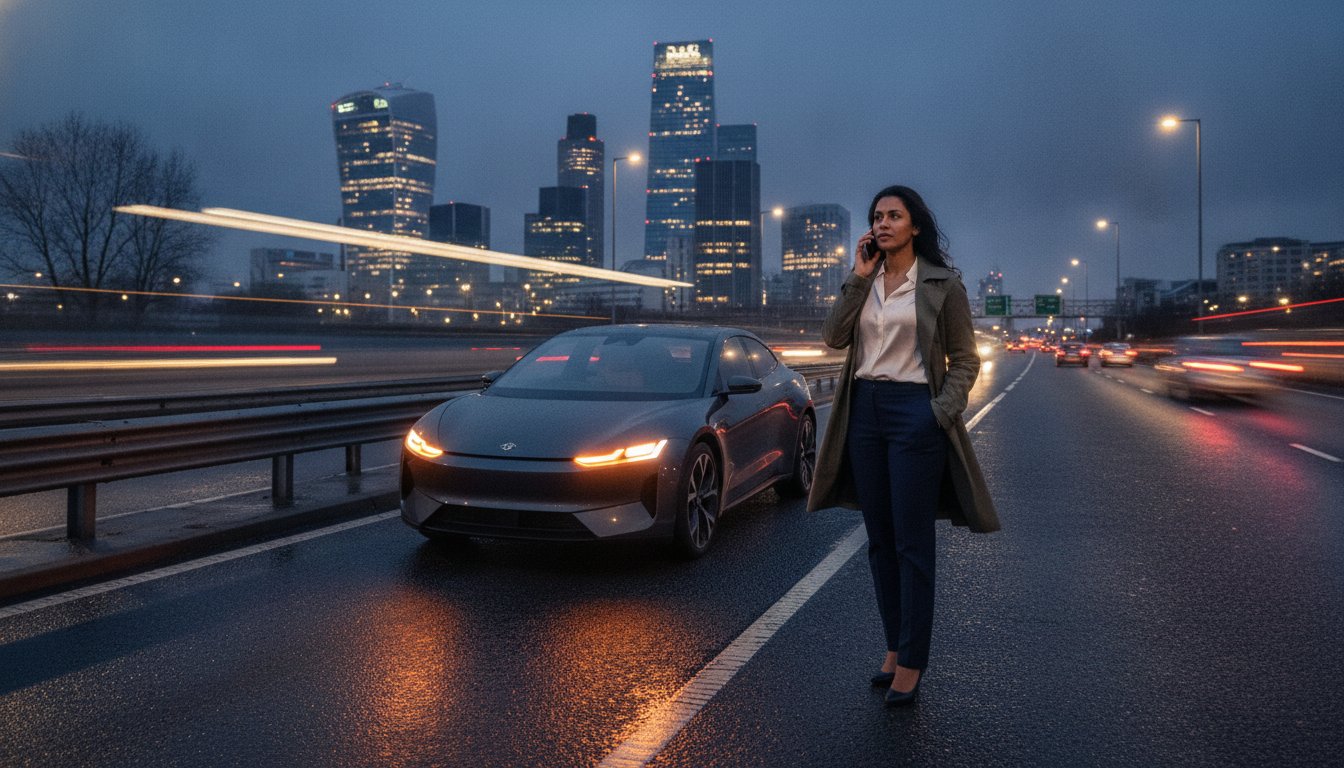
Imagine you’re navigating the evening rush on the A12 when your engine suddenly cuts out, leaving you stranded on a Red Route with traffic streaming past. It’s a situation that triggers instant panic; you aren’t just worried about your safety, but also the looming threat of a £160 fine for stopping in a restricted zone. We understand that a breakdown in the capital feels far more intense than anywhere else. Whether you’re concerned about the logistics of the expanded ULEZ or the sheer volume of traffic, your anxiety is completely valid.
This guide explains exactly what to do if car breaks down London to ensure you stay safe and avoid unnecessary penalties. We’ll walk you through the immediate steps to protect your passengers, the latest 2026 regulations for the £18 Congestion Charge zone, and how to organise a reliable recovery to a safe location. By the end of this article, you’ll have a clear, calm plan to get back on track without the stress or the unexpected costs.
Key Takeaways
- Prioritise immediate safety by activating your hazard lights and moving your vehicle as far to the left as possible to protect yourself and other motorists.
- Understand the specific regulations for Red Routes to avoid a £160 penalty charge whilst waiting for professional assistance to arrive.
- Learn exactly what to do if car breaks down London, including how to navigate the logistical requirements of the ULEZ and Congestion Charge zones during a recovery.
- Identify whether your situation requires a simple roadside jumpstart or tyre change, or if a full vehicle recovery is the most secure option for your journey.
- Discover why choosing a local specialist in East London and Essex ensures faster response times and a more empathetic, personalised service during a crisis.
Immediate Safety Steps: What to Do the Second You Break Down
A sudden vehicle breakdown in the middle of a busy London street can feel overwhelming. The first few seconds are critical for your safety. If you’re wondering what to do if car breaks down London, the priority is always visibility and distance from moving traffic. We understand the panic that sets in when your engine fails amongst thousands of other motorists, but taking a few methodical steps can prevent a stressful situation from becoming a dangerous one.
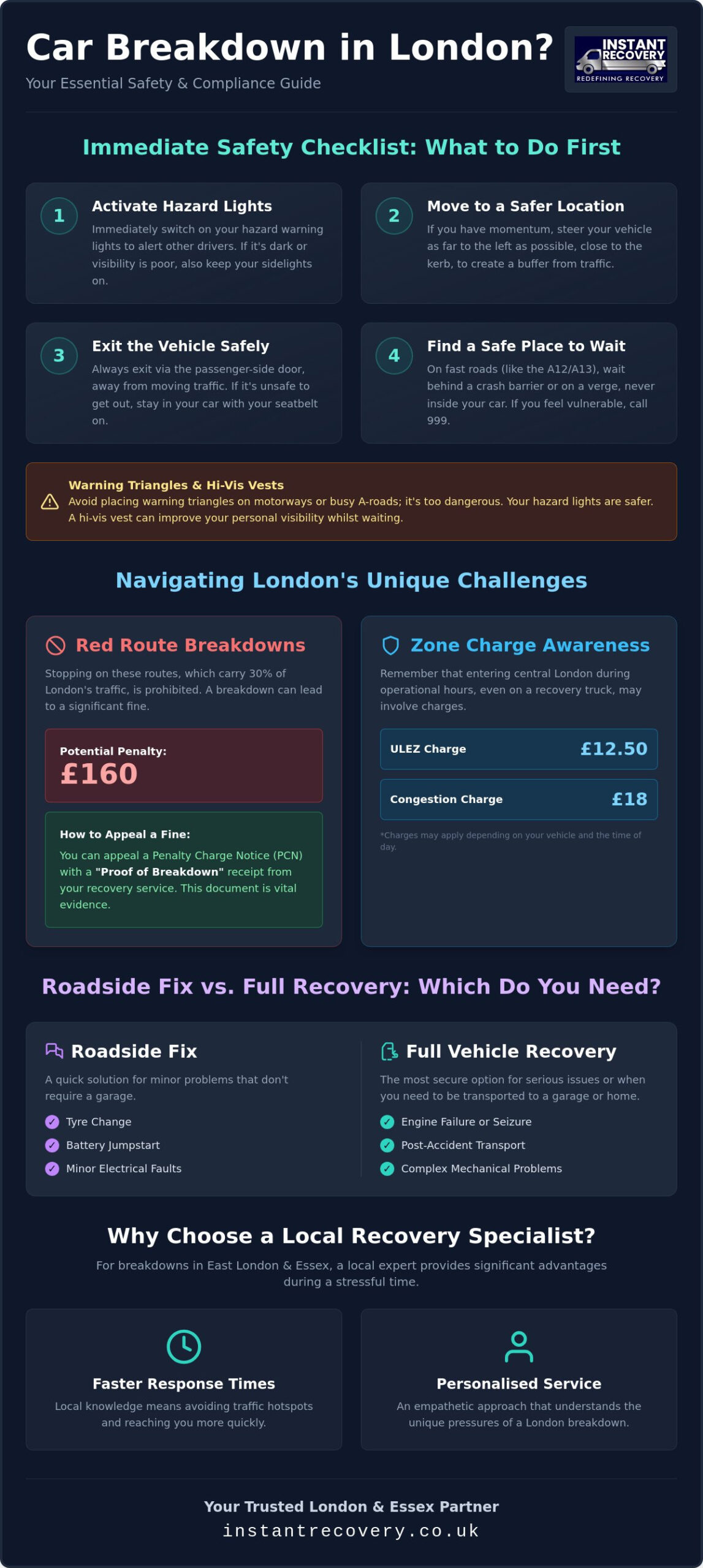
Your first action must be to switch on your hazard warning lights. This simple move alerts other drivers that you’re a stationary hazard, which is vital in London’s dense, fast-moving traffic. If your car still has some momentum, steer it as far to the left as possible. Whether you’re on a quiet residential street in Ilford or a fast-moving section of the A406, getting closer to the kerb creates a buffer between you and the flow of vehicles. If it’s dark or the weather is poor, keep your sidelights on to ensure you remain visible from a distance.
Once the car is stationary, you must exit the vehicle. However, never step out into a live lane of traffic. Always use the passenger-side door to exit, even if it means climbing over the centre console. This keeps you away from passing cars and significantly reduces the risk of an accident. If you can’t get out safely, stay in the car with your seatbelt on and call for emergency help immediately. Our team is always ready to support you, but your physical safety is the most important factor in these early moments.
Finding a Safe Place to Wait
On high-speed roads like the A12 or A13, the rules of safety change. You should never stay inside the car whilst waiting for recovery on these routes. Instead, move behind a crash barrier or onto a verge if one is available. If you’re a vulnerable driver, such as someone travelling alone at night or with young children, it’s often best to call 999 alongside your recovery service. They can provide a police presence to shield your vehicle whilst you wait for our professional team to arrive and secure your car.
Using Warning Triangles in the City
While the Highway Code suggests placing a warning triangle 45 metres behind your car, this is often impossible on narrow London streets. You should never use a triangle on a motorway or a dual carriageway; it’s far too dangerous to walk along the road to set it up. In the city, focus on staying visible by wearing a hi-vis vest if you have one. If you’re on a quiet Essex lane, a triangle can be helpful, but on London’s busy A-roads, your hazard lights and a safe waiting position are your best forms of protection.
Navigating London’s Red Routes and High-Traffic Logistics
Breaking down in the heart of the city introduces a layer of logistical complexity you won’t find on a quiet country lane. Beyond the mechanical failure, you’re suddenly faced with the strict enforcement of London’s Red Routes, which carry 30% of the city’s traffic despite making up only 5% of the roads. If you’re stuck on a double red line, the pressure to move is immense. Knowing what to do if car breaks down London involves more than just popping the bonnet; it requires a quick understanding of how to avoid a £160 Penalty Charge Notice (PCN) whilst ensuring your vehicle is recovered safely.
Speed of communication is your best tool here. When you call for help, try to be as specific as possible about your location. Whilst landmarks like the Stratford Centre or the Barking flyover are helpful, using an app like “what3words” provides our dispatch team with a precise three-metre square location. This is especially vital on “Smart Motorway” sections of the M25 or M11 where there is no permanent hard shoulder. If you can’t reach an Emergency Refuge Area, your priority is to alert the authorities and then connect with a local recovery specialist who knows these high-pressure routes intimately. Keeping a cool head helps us reach you faster.
Red Routes and TfL Fines
While stopping on London’s Red Routes is strictly prohibited, Transport for London (TfL) does recognise that genuine emergencies happen. You aren’t automatically exempt from a fine, but you can appeal it successfully with the right “Proof of Breakdown.” We always provide our customers with a detailed professional recovery receipt. This document serves as vital evidence for your appeal, showing the exact time and location our team arrived to assist you. If you’re stranded in a restricted zone, notify TfL via their contact channels as soon as it’s safe to do so to log the incident.
ULEZ and Congestion Zone Considerations
Navigating the £12.50 ULEZ or the £18 Congestion Charge zone adds another financial worry to your day. If your non-compliant vehicle is being carried on one of our recovery trucks, it typically won’t trigger a charge for the car itself, though the recovery vehicle must be compliant. We manage these zone entries carefully to keep your costs predictable and fair. For a deeper look at navigating these specific city challenges, our guide to Emergency Roadside Assistance in London offers a complete breakdown of what to expect. If you find yourself in this situation, contacting a local expert ensures these logistics are handled with care and integrity.
Roadside Fix vs. Full Recovery: Which Do You Need?
Whether you’re stranded in a quiet residential street or at a major junction, the first question on your mind is likely: “Can I get moving again now?” Deciding between a quick roadside fix and a full vehicle recovery depends entirely on the nature of the fault. Whilst some issues are minor, others require professional equipment to move the car safely. Understanding what to do if car breaks down London starts with a calm assessment of your vehicle’s symptoms. A flat battery or a punctured tyre can often be resolved on the spot, whereas engine smoke or a snapped cambelt will almost certainly require a tow.
Opting for a roadside fix is often the most efficient way to handle a crisis. It saves you the time of a garage visit and is generally more cost-effective than a long-distance tow. However, you must always follow official government advice regarding safety before you even consider the mechanical side. If the car has suffered major accident damage or a total mechanical failure, a full recovery is unavoidable. In these high-stress moments, we prioritise getting you and your vehicle to a safe location with as little disruption as possible.
Emergency Jump-Starts and Tyre Changes
London’s stop-start traffic is notoriously brutal on car batteries. Constant idling and short journeys don’t give the alternator enough time to recharge the system, leading to sudden failures. Similarly, the city’s potholes can claim a tyre in seconds. Attempting a DIY tyre change on a narrow, busy street is incredibly dangerous due to the proximity of passing vehicles. If your car won’t start or you have a flat, our Car Breakdown Recovery East London team can provide a professional jump-start or tyre change to get you back on your way safely.
Full Vehicle Towing and Transport
When a roadside fix isn’t possible, we use specialised equipment to transport your vehicle. We often choose between flatbed towing and spectacle lifts depending on your car’s drive system and the location’s accessibility. For those driving modern electric vehicles, a flatbed is almost always a requirement to avoid damaging the regenerative braking systems. Whether you’re driving a compact city car or a premium SUV, we treat your property with personal care. For more details on handling modern cars, see our guide on Electric Vehicle Recovery London.
How to Choose a Reliable Recovery Service in London
When you are faced with a mechanical failure in the middle of a busy junction, the pressure to make a quick decision is immense. However, choosing the wrong provider can lead to long wait times and unexpected costs. When deciding what to do if car breaks down London, selecting a partner who combines technical expertise with a genuine sense of care is essential. You need more than just a tow; you need a professional who understands the urgency of your situation and treats your vehicle with the respect it deserves.
Our commitment to quality is mirrored by other local professionals we trust; We are a trusted plumbing & Heating company providing reliable, high-quality services across London and Kent.
Local knowledge is often the deciding factor in how quickly you are rescued. While national breakdown organisations have large fleets, their dispatch systems often struggle to account for the unique, shifting congestion patterns of the Barking and Essex corridor. A local firm based in East London will be familiar with the “back routes” through Stratford and Ilford that allow them to bypass gridlock. This local expertise ensures that help arrives whilst you are still managing the initial stress of the breakdown, rather than hours later.
The Problem with National Membership Wait Times
Large national call centres often provide an estimated time of arrival (ETA) that doesn’t reflect the reality of London’s peak-hour traffic. Whether you are a member of a major club or looking for a “pay-on-use” service, the sheer volume of calls these organisations handle can lead to significant delays. Choosing a local specialist allows for a more direct line of communication. You aren’t just a number in a queue; you’re a neighbour in need of assistance, and the response time usually reflects that personal priority.
Verifying Credentials and Insurance
Before any equipment is attached to your car, it is vital to verify that the provider is fully insured. A reputable service will carry “goods in transit” insurance, which protects your vehicle from the moment it is hooked up until it reaches its destination. Don’t be afraid to ask the driver about their credentials or the safety of their equipment. Providing a clear, transparent “Free Estimate” before work begins is a hallmark of a reputable London provider, ensuring you aren’t hit with hidden “hook-up” fees or inflated mileage charges later on.
Ultimately, the quality of the team matters as much as the quality of the truck. A professional recovery crew acts as a “Caring Guardian” during your crisis, offering reassurance and clear instructions to keep you safe. If you find yourself stranded and need an honest, efficient, and local solution, reaching out for professional vehicle recovery is the most reliable way to get home safely.
Instant Recovery: Your Trusted London & Essex Partner
At Instant Recovery, we believe that providing vehicle assistance is about more than just moving machinery; it’s about protecting people. We have built our reputation as a “Caring Guardian” for motorists across East London and Essex, offering a steady hand when situations feel chaotic. Whether you are stranded in Barking, Ilford, Stratford, or Romford, our team is available 24/7 to ensure you are never left alone. Knowing what to do if car breaks down London is the first step, but having a reliable partner to call is the second. We treat every vehicle with the same respect and integrity we would show our own, ensuring that your property is handled with personal care from the moment we arrive.
Our services are designed to be both urgent and efficient, acknowledging that every minute spent on a busy road is a minute too long. We specialise in fast roadside assistance, including jump-starts and emergency tyre changes, to get you moving without the need for a tow whenever possible. If a full recovery is required, we provide transparent, flat-rate pricing with no hidden surprises related to London’s various charging zones. Our goal is to move you from distress to resolution with a calm, professional approach that you can rely on.
Why East London Drivers Choose Us
Our deep familiarity with the A12, A13, and the North Circular allows us to navigate traffic patterns that often baffle larger, national providers. We understand how these specific routes behave during peak hours, which enables us to find the most efficient way to reach you. By focusing our expertise on the local community, we keep our prices affordable and our response times short. For a comprehensive look at how we support motorists in the capital, you can explore our Professional Vehicle Recovery London pillar.
Contacting Instant Recovery in an Emergency
When you contact us in an emergency, our methodical dispatch process ensures we can provide a free estimate and send help in under two minutes. To help our team reach you as quickly as possible, please try to have your vehicle’s make, model, and a specific location or landmark ready. Whether you are facing a simple dead battery or a major mechanical failure, we have it under control. Our approachable professionals are ready to help you navigate the logistics of your breakdown so you can focus on getting home safely.
Stay Safe and Secure on London’s Roads
Navigating a vehicle failure in the capital doesn’t have to be a source of lasting stress. By prioritising your immediate safety, understanding the specific logistics of Red Routes, and choosing a local specialist who knows the North Circular as well as you know your own street, you can manage the situation with confidence. Now that you understand exactly what to do if car breaks down London, you can stay calm and focused on the solution rather than the problem.
Being a confident driver starts with the right foundation; for those in South West London, Wimbledon Driving School provides the expert training needed to handle city roads with ease.
Whether you are facing a flat tyre in Barking or a sudden engine failure in Stratford, our team is ready to act as your reliable neighbour on the road. We provide 24/7 emergency dispatch and specialise in East London and Essex, offering transparent flat-rate pricing so you never have to worry about hidden costs during a crisis. If you need assistance right now or simply want to be prepared for the future, Get a Free Recovery Estimate from Instant Recovery. We are here to ensure that no matter what happens, you and your vehicle are always in safe hands.
Frequently Asked Questions
What should I do if my car breaks down on a London Red Route?
If you break down on a Red Route, you must activate your hazard lights immediately and attempt to move the vehicle to a safe location if it is still mobile. While stopping is prohibited, Transport for London recognises genuine emergencies. You should ensure you receive a professional recovery receipt from our team, as this document is essential evidence for appealing any automated penalty charge notice you might receive.
How long does car recovery usually take in London traffic?
Response times vary depending on the time of day and your specific location within the city. Local specialists in East London and Essex can often reach areas like Barking, Stratford, or Ilford faster than national providers by using known back routes to bypass major congestion. We prioritise urgent dispatch to ensure you aren’t left waiting on a busy road for longer than necessary.
Do I have to pay the Congestion Charge if my car is being towed?
You generally aren’t required to pay the Congestion Charge if your vehicle is being carried entirely on a recovery truck. If the car is being towed with its wheels on the road, it may still trigger the automated cameras. When we handle your recovery, we manage the logistics of zone entries to keep the process as simple and transparent as possible for you.
Is it safe to stay in my car while waiting for recovery on a busy A-road?
It is almost always safer to exit your vehicle and wait behind a crash barrier or on a verge when you are on a busy A-road. You should exit through the passenger door to stay away from live traffic lanes. This is a vital part of what to do if car breaks down London, as it protects you from the risk of rear-end collisions.
Can you jump-start my car if the battery died in a multi-storey car park?
Yes, we can provide a professional jump-start even in the tightest multi-storey car parks using portable power packs. Whether your vehicle is on the ground floor or the top level, our equipment is designed to reach you without needing a large recovery truck to enter the building. We will have your engine running and your journey back on track in no time.
What is the cost of car recovery in London without a membership?
The cost of “pay-on-use” recovery depends on several factors, including the distance of the tow and the time of day. We provide transparent, flat-rate pricing to ensure you don’t face unexpected surcharges for ULEZ or Congestion Zone entries. Our team will always give you a clear estimate before we dispatch a driver, so you can feel confident in the service you’re receiving.
Can you recover my electric vehicle (EV) if it runs out of charge in London?
We can recover any electric vehicle that has run out of power using our specialised flatbed recovery trucks. It is essential to use a flatbed because towing an EV with its wheels on the ground can cause significant damage to the regenerative braking system. We will transport your car safely to the nearest charging station or directly to your home address.
What happens if my car breaks down on the M25 near London?
If you break down on the M25, you should try to reach the next exit or an Emergency Refuge Area. If you are forced to stop in a live lane on a “Smart Motorway” section, stay in the car with your seatbelts on and call 999 immediately. Once the motorway authorities have closed the lane and secured the area, our team can safely perform a vehicle recovery.