
Last Tuesday, a commuter on the A406 discovered how quickly a morning can spiral when their engine cut out amidst heavy traffic. It’s a high-stress situation, and the uncertainty of when help will arrive often feels worse than the breakdown itself. You likely want a quick resolution, yet the average car recovery time London motorists experience in 2026 is a complex science of traffic flow and local geography. We understand that in these moments, you don’t just need a tow truck; you need a reassuring voice and a realistic timeline to regain control of your day.
This guide replaces that anxiety with clear, actionable information about what you can truly expect when you call for assistance. Whether you’ve suffered a flat tyre in East London or need a jump-start in the heart of the city, we’ll break down the factors that influence arrival times and the essential safety steps you should take while waiting. You’ll gain a better understanding of how local expertise ensures a faster response, giving you the confidence that a reliable neighbour is already on the way to get you home safely.
Key Takeaways
- Understand that the average car recovery time London motorists face typically ranges between 30 and 60 minutes, though this is heavily influenced by your specific location.
- Identify how external factors like school run congestion, peak-hour traffic on the A13, and the unique layout of East London boroughs can impact arrival speeds.
- Learn the practical steps you can take to stay safe whilst waiting and the specific location tools that help a recovery team find you faster.
- Discover why choosing a local expert who understands Essex and London shortcuts provides a more reliable and reassuring experience than national alternatives.
- Find out how clearly describing your vehicle’s fault can ensure the correct equipment is sent, potentially leading to a quicker roadside resolution.
What is the Realistic Average Car Recovery Time in London?
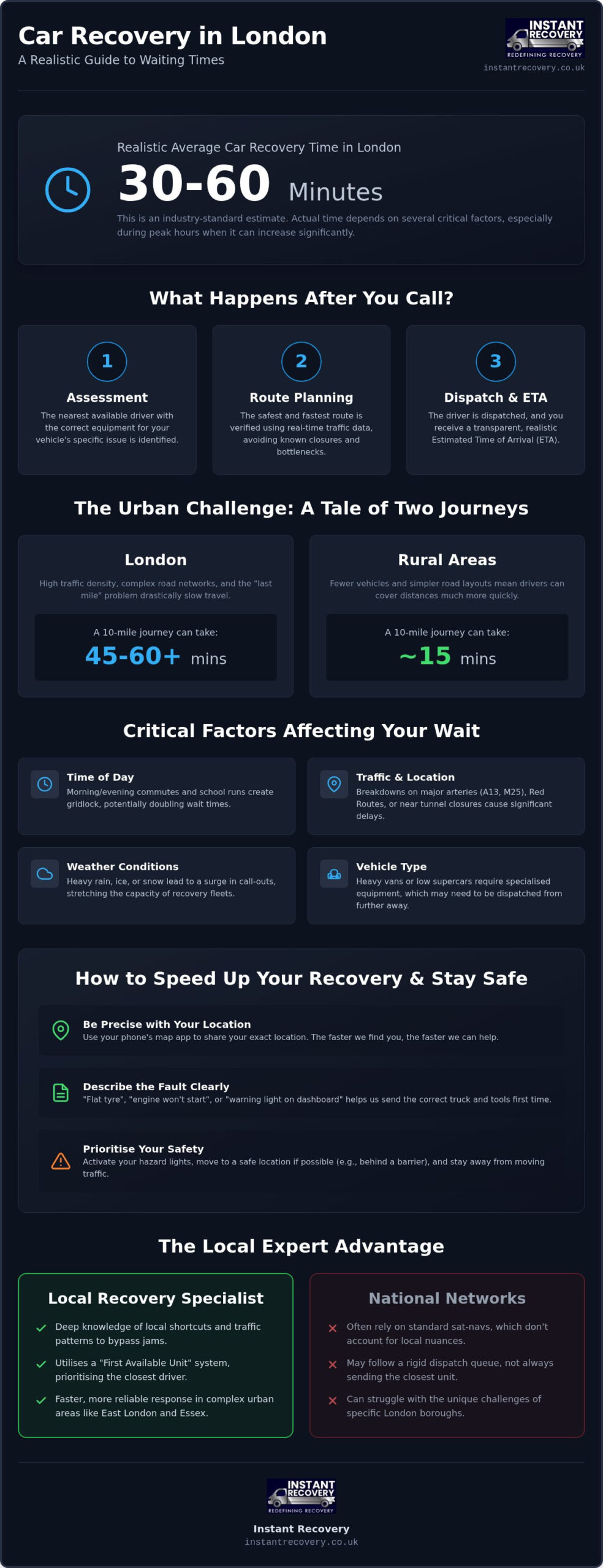
The average car recovery time London motorists encounter is the specific window from the moment a dispatch is confirmed until the recovery vehicle arrives on-site. Whilst many providers aim for speed, the industry standard in the capital typically sits between 30 and 60 minutes. It’s vital to recognise that these arrival times are professional estimates rather than rigid guarantees, simply because the city’s road network is famously unpredictable.
Whether you’re stuck in a quiet residential street or on a busy arterial road, timing is everything. During off-peak hours, you might see a driver arrive in under half an hour. However, during the morning commute or the school run, that waiting period can increase by 100% as recovery units navigate the same gridlock as everyone else. We know that waiting by the roadside is stressful, so providing a realistic expectation is part of our commitment to your peace of mind.
The 30-60 Minute Window: Why It Exists
The journey to your side begins the second you hang up the phone. Dispatch logistics involve a sequence of essential steps to ensure we get it right the first time:
- Identifying the nearest driver with the correct equipment for your vehicle.
- Verifying the safest route based on real-time traffic data and road closures.
- Confirming the dispatch and providing you with a transparent arrival estimate.
At Instant Recovery, we utilise a “First Available Unit” system. This means we prioritise the driver who can reach you quickest, rather than following a rigid queue that doesn’t account for location. Independent local firms often have an advantage over national brands in urban centres. Whilst a national fleet might have more trucks, they often lack the granular knowledge of local shortcuts in boroughs like Newham or Barking. A local provider acts as a reliable neighbour, using years of experience to bypass known bottlenecks that sat-navs might miss.
London vs. The Rest of the UK: A Timing Comparison
Comparing London to rural areas highlights why urban Vehicle recovery is a different challenge altogether. In rural Essex or Kent, a driver might cover ten miles in fifteen minutes. In London, the population density and traffic volume mean those same ten miles could take an hour. Understanding the average car recovery time London residents face compared to rural neighbours helps set realistic expectations during a crisis.
The “Last Mile” problem is a significant factor here. A driver might make good progress on the A13, only to spend twenty minutes navigating the final two miles of narrow streets or width restrictions. Because the volume of recovery calls is so much higher in the city, units are constantly on the move, making the logistical dance of reaching you safely a precision task.
Critical Factors Affecting Your Recovery Arrival Time
Whether you are stranded on the shoulder of the A13 or tucked away in a quiet side street, several external forces dictate how quickly help reaches you. The average car recovery time London drivers experience is never a static figure because it is tied directly to the city’s pulse. Traffic density remains the primary variable. According to Official road traffic statistics, the volume of vehicles on major London arteries can fluctuate wildly, meaning a journey that takes ten minutes at midnight could take forty minutes during the afternoon peak.
Time of day plays a massive role in our response speed. Morning commutes and school runs create a ripple effect across the network, slowing down recovery units as they navigate through school zones and congested junctions. Similarly, weather conditions like heavy rain or winter ice lead to a natural spike in breakdowns. When fleet capacity is stretched by a sudden surge in calls, it requires careful management to ensure we reach the most vulnerable drivers first. The type of vehicle also matters. Whilst a standard hatchback is straightforward to tow, a heavy van or a low-slung supercar may require specialised low-loader equipment, which might be dispatched from a different depot.
London Geography: The North Circular and Red Routes
Being stranded on a Red Route often changes the priority of a recovery. Because these are critical for London’s traffic flow, authorities often demand faster clearance, which can actually speed up the arrival of a recovery unit. However, geography can also work against us. Frequent closures of the Blackwall Tunnel or Rotherhithe Tunnel force our drivers into lengthy diversions, often through Tower Bridge or even out towards the Dartford Crossing. East London areas like Barking, Ilford, and Stratford have unique traffic patterns that only a local expert truly understands. If you need assistance in these areas, our team at Instant Recovery provides reliable support with an intimate knowledge of local shortcuts.
Regulatory Hurdles: ULEZ and Congestion Charges
Modern recovery fleets must be highly adaptable to navigate London’s regulatory landscape. The Ultra Low Emission Zone (ULEZ) and the Congestion Charge zone require compliant vehicles to avoid hefty daily fees. Whilst our fleet is fully prepared for these zones, the logistics of routing around restricted areas for non-compliant vehicles or navigating through the heart of the city can add 10 to 15 minutes to an arrival time. We always aim for the most direct path, but we must balance speed with the specific legal requirements of the vehicle we are recovering.
Response Times by Road Type: M25 vs. Residential Streets
The environment where your vehicle fails plays a decisive role in how quickly help arrives. Motorway hard shoulders require specific safety protocols that can influence dispatch, as these high-speed environments present a significant risk to both the driver and the recovery professional. Because of this, calls from the M25 or M11 often receive priority status to ensure motorists are moved to a place of safety as quickly as possible. When calculating the average car recovery time London motorists can expect, we must distinguish between the high-speed urgency of a motorway and the logistical maze of a residential borough.
Motorway Recovery: M25 and A-Road Dynamics
Residential towing in boroughs like Newham or Havering presents a different set of challenges. Whilst motorway recovery is focused on speed and safety, inner-city work is often a test of navigation. Narrow streets, residential parking zones, and width restrictions can prevent larger recovery trucks from taking the most direct route. Local roadworks and temporary diversions add further layers of complexity that can nudge the average car recovery time London drivers experience toward the upper end of the 60-minute window.
The specific location of your breakdown also dictates the equipment we send. Whether you are facing a mechanical failure in a tight cul-de-sac or a multi-storey car park with low clearance, the kit required changes. If your issue is a simple battery failure, our Jumpstart units can often navigate these narrow streets and height-restricted areas faster than a full tow truck. This flexibility allows us to provide a more efficient service, getting you back on the road without the need for a larger flatbed vehicle when a simpler solution is available.
How to Minimise Your Waiting Time and Stay Safe
While we work hard to keep the average car recovery time London drivers experience as low as possible, your actions in the first few minutes can significantly impact the speed of our arrival. Whether you are facing a minor tyre issue or a total engine failure, providing precise information allows us to dispatch the most suitable vehicle immediately. The more accurate you are, the less time our driver spends searching for you amongst the urban sprawl.
Using modern tools like What3Words or a Google Maps pin removes the guesswork from urban navigation. Instead of describing a vague landmark, you provide a three-metre square location that our drivers can plug directly into their navigation systems. This precision ensures we don’t waste time circling the block, which is a common cause of delay in densely populated East London boroughs. Once you have made the call, keep your phone line clear. Our team or the driver may need to contact you for a final location check or to provide a safety update.
Clearly describing the fault is just as vital for an efficient response. If you need an emergency tyre change, we can often send a more agile unit that navigates traffic easily. However, if your vehicle is a non-runner, we must ensure a flatbed is dispatched. Getting these details right at the start prevents the frustration of the wrong equipment arriving at your side.
Safety Protocols While Waiting in London
Your safety is our absolute priority while help is on the way. If you break down on a “Smart Motorway” section of the M25, try to reach an Emergency Area. If that is not possible and you are in a live lane, keep your hazard lights on and stay inside the vehicle with your seatbelts fastened. In most other London environments, you should exit the vehicle via the passenger side and find a safe vantage point well away from the flow of traffic. For a comprehensive list of safety steps, you can read our full guide on What to Do If Your Car Breaks Down in London.
Information You Must Have Ready for Dispatch
To help us organise the logistics of your recovery, please have the following details ready when you call:
- Vehicle registration, make, model, and the specific colour.
- The exact number of passengers, including any need for child seats.
- Your intended destination, whether it is your home address or a local garage.
Providing the destination address early allows our dispatch team to calculate the most efficient route for the entire journey before the driver even reaches you. This methodical approach ensures that once your vehicle is loaded, we can get you moving toward your destination without further delay.
Why Instant Recovery Offers Rapid Response in East London and Essex
When you are stranded at the roadside, the average car recovery time London providers offer becomes more than just a statistic; it is a lifeline. Our response model is built on strategic proximity, with units positioned specifically to serve East London and Essex. By basing our fleet in areas like Barking, Dagenham, and Ilford, we ensure that a driver is always within reach of the major thoroughfares that connect our communities. This local presence allows us to offer a sense of calm and reliability when you need it most.
We operate a 24/7 service designed to handle the unique rhythm of London’s traffic cycles. Whether it is a midnight breakdown on a deserted road or a rush-hour incident on the A13, our team is ready to assist. We move away from the cold, transactional feel of national fleets, choosing instead an empathetic approach that treats every driver as a “Reliable Neighbour.” Part of this commitment to integrity involves providing transparent, free estimates before we even dispatch a unit. Knowing the costs upfront reduces the anxiety of an already stressful situation, allowing you to focus on your safety while we handle the logistics.
Local Expertise: Navigating East London Shortcuts
Our drivers possess an intimate knowledge of the IG, RM, and E postcode areas, which is a significant advantage in maintaining a competitive average car recovery time London motorists can rely on. This deep local expertise allows our team to bypass major jams on the A13 or the M25 by using proven shortcuts that only a resident expert would know. If you require Car Breakdown Recovery East London, you benefit from a team that understands the specific quirks of Stratford’s one-way systems or the narrow residential roads of Romford.
Beyond Towing: Immediate Roadside Fixes
We believe that getting you back on the road safely should be the first priority, which is why we often focus on roadside fixes rather than a long tow. Our units are equipped for an emergency jump start or rapid tyre changes to resolve the issue where you stand. This efficiency not only saves you time but also reduces the disruption to your day. The Instant Recovery promise is built on honesty and professional care; we only suggest a full tow if it is the safest and most appropriate option for your vehicle’s condition. Every interaction is handled with the same level of respect and attention to detail that we would give our own vehicles.
Regaining Control of Your Journey
Breakdowns are inherently stressful, but they don’t have to define your entire day. By understanding that the average car recovery time London motorists face is shaped by traffic density and local geography, you can set realistic expectations and stay calm. Whether you’re waiting on the M25 or a quiet residential street in Havering, your safety remains the top priority. Remember to use digital location tools and keep your phone line clear to help our drivers reach you without delay.
Our team at Instant Recovery is here to act as your reliable neighbour across East London and Essex. We provide 24/7 emergency response with a professional, empathetic approach that puts your well-being first. With no hidden fees and a commitment to honest, transparent service, we ensure you have the support you need to get back on the road safely.
Get a Free Recovery Estimate from Instant Recovery and let us handle the hard work for you. You’re never alone when help is just a phone call away.
Frequently Asked Questions
How long does a tow truck take to arrive in London?
A tow truck in London typically takes between 30 and 60 minutes to arrive at your location. This window represents the average car recovery time London motorists should expect during standard conditions. Whilst we aim for the faster end of this scale, factors such as your specific borough and the current traffic volume play a significant role. Providing a precise location via digital pins helps our team reach you as efficiently as possible.
Is car recovery faster at night in London?
Car recovery is often faster at night because the reduced traffic volume allows our drivers to navigate the city Road network with fewer obstacles. Without the congestion of the morning commute or the school run, response units can reach boroughs like Barking or Dagenham more directly. We maintain a 24/7 operation to ensure that help is available regardless of the hour, providing a sense of calm and reliability during late-night emergencies.
What factors cause delays in London car recovery?
Several logistical challenges can cause delays, most notably high traffic density on major arteries like the A13 or the North Circular. Adverse weather conditions, such as heavy rain or winter ice, often lead to a higher volume of calls, which can stretch fleet capacity across the city. Additionally, specific vehicle requirements, such as the need for a low-loader for a supercar, may require a specialised unit to travel from a further depot.
Can I get car recovery on the M25 within 30 minutes?
Reaching a vehicle on the M25 within 30 minutes is possible if a recovery unit is already positioned near your specific junction. However, motorway recovery involves strict safety protocols and often requires navigating to the next available exit to double back. Because these are high-speed environments, we treat these calls with the highest urgency to ensure you are moved to a safe location as quickly as the current traffic conditions allow.
Do I have to stay with my car while waiting for recovery?
You should always prioritise your personal safety over staying directly with the vehicle. If you are on a busy A-road or a motorway, it’s safer to exit the car from the passenger side and wait behind a safety barrier or on a verge. Whether you are in a residential area or on a Red Route, we recommend finding a safe vantage point whilst keeping your phone line clear for the driver’s arrival.
How much does emergency car recovery cost in London?
The cost of emergency car recovery in London depends on several variables, including the total distance of the tow and the time of day. Factors like whether you need a simple jump-start or a full vehicle recovery to a garage will influence the final fee. We understand that financial transparency is vital during a crisis, which is why we offer free estimates upfront. This approach ensures you know exactly what to expect without hidden charges.
Does ULEZ affect how long I wait for a recovery vehicle?
The Ultra Low Emission Zone (ULEZ) can impact waiting times if a recovery provider needs to route a specific vehicle around restricted areas. Whilst our fleet is fully compliant with modern emissions standards, navigating the heart of the Congestion Charge or ULEZ zones involves complex traffic patterns. This regulatory landscape can occasionally add 10 to 15 minutes to an arrival time as drivers work to find the most efficient and legal route.
What should I do if my car breaks down on the North Circular?
If you break down on the North Circular, immediately turn on your hazard lights and try to pull into a safe gap or onto the verge. Exit the vehicle away from the flow of traffic and find a secure spot to call for assistance. Because the A406 is one of the busiest roads in the UK, it’s essential to use a local expert who understands the specific junctions and the unique safety risks involved.