

You are parked on a busy Red Route in Central London, the dashboard is glowing with unfamiliar symbols, and when you turn the key, there is nothing but a hollow click. It is a moment that brings an immediate wave of anxiety, especially when you are mindful of the city’s strict parking regulations and the potential £180 penalty for blocking traffic. We understand that when your car won’t start London can feel like an incredibly difficult place to be stranded. Whether you are worried about ULEZ charges or you feel overwhelmed by a flashing warning light, we are here to offer a composed and dependable path forward.
We believe every driver deserves a calm, reliable helper when things go wrong. Discover why your car won’t start and learn the exact steps to take to get back on the road safely in London. We will provide a quick diagnosis of common issues like battery failure, explain how to avoid a parking ticket whilst you are immobile, and show you how to find professional assistance fast. From a simple jumpstart to expert vehicle recovery, we have organised the essential information you need to move from distress to a clear resolution.
Key Takeaways
- Identify the most common electrical and mechanical culprits, such as flat batteries or faulty starter motors, to help you understand why your engine is failing to fire.
- Gain practical advice on managing London-specific challenges, including how to handle a breakdown on a busy Red Route or within a charging zone.
- Follow a step-by-step safety guide to protect yourself and your passengers whilst waiting for assistance on the city’s high-traffic A-roads.
- Discover the exact moment to move from troubleshooting to calling for professional help when your car won’t start London, ensuring you avoid unnecessary fines or danger.
Understanding Why Your Car Won’t Start in London
A non-start event is defined simply as the moment your ignition fails to fire the engine. In a quiet driveway, this is a nuisance; however, in the middle of the Blackwall Tunnel or on a busy South London high street, it feels like a genuine crisis. The psychological pressure of blocking traffic whilst hearing the impatient honks of other drivers can make it incredibly hard to think clearly. We understand that when your car won’t start London can feel like a very lonely place, but identifying the symptoms is the first step toward a calm resolution.
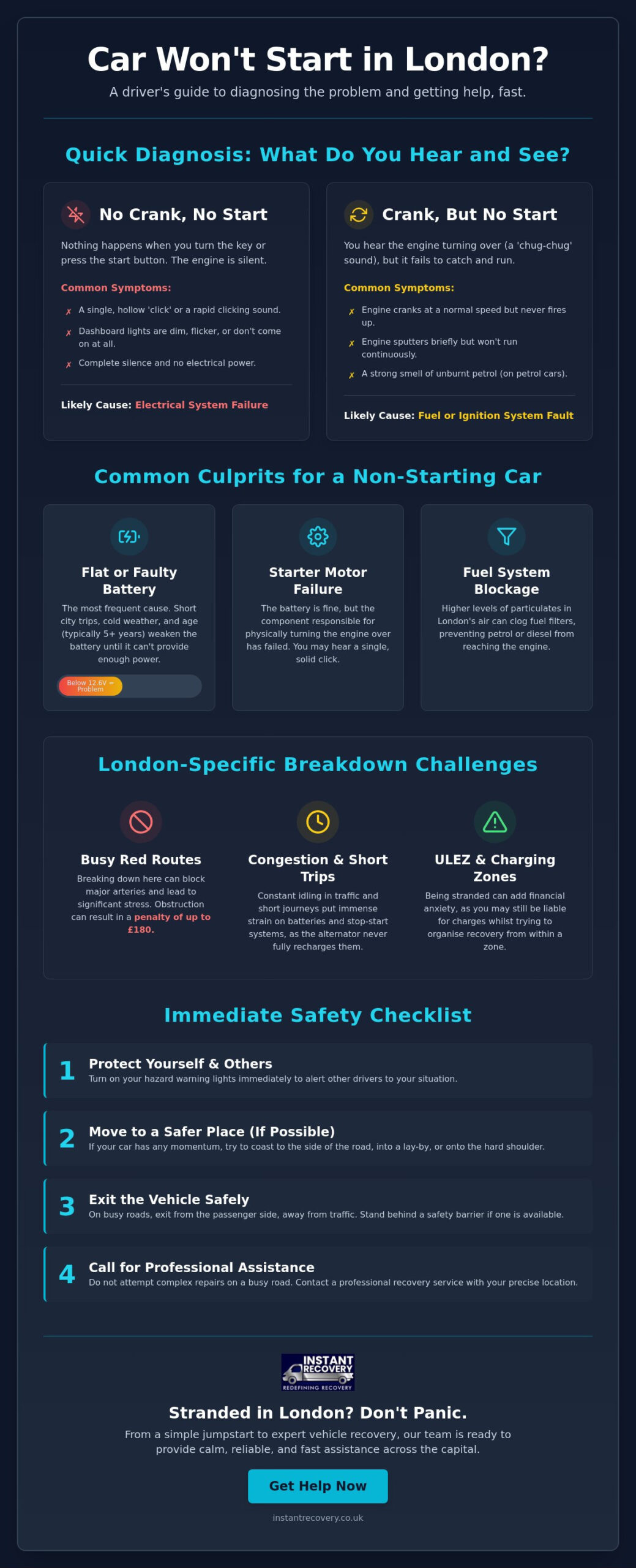
You should first determine if you are dealing with a “no-crank” or a “crank-but-no-start” scenario. A no-crank situation means nothing happens when you turn the key or press the start button, which usually points to an electrical failure. Conversely, if the engine turns over with a familiar “chug-chug” sound but refuses to catch, the issue is likely related to fuel delivery or the ignition system. Distinguishing between these two helps you communicate more effectively with a recovery specialist.
The Most Common Culprits in the Capital
London’s unique urban environment is notoriously difficult for vehicles. Many residents only use their cars for short school runs or quick trips to the local shops. These brief journeys mean the alternator never has enough time to fully recharge the battery. Over time, this leads to a steady decline in power until the morning comes when the engine simply won’t turn. It is a common pattern that we see across all boroughs.
Modern vehicles equipped with stop-start technology rely on advanced AGM batteries to handle frequent engine cycles. Whilst these are robust, the constant idling and restarting in heavy London congestion puts them under immense strain. Additionally, the capital’s air quality and higher levels of particulates can occasionally lead to premature clogging of fuel filters. This restricts the flow of petrol or diesel, making it nearly impossible for the engine to fire even if the battery is healthy.
Initial Signs and Symptoms
Listening to your car can provide vital clues about the underlying problem. If you hear a rapid clicking sound when you turn the key, it’s usually the starter motor solenoid failing to engage because the battery voltage is too low. You might also notice that your dashboard lights appear dim or flicker when you attempt to crank the engine, which is a classic sign of a failing power cell.
If you have a petrol car and can smell unburnt fuel, you might have a flooded engine. This happens when too much fuel enters the combustion chamber without igniting, often after several failed attempts to start. Before you look into how to safely jump-start your car, it is worth waiting a few minutes to let the excess petrol evaporate. Recognising these symptoms early allows you to provide accurate information when you need to report that your car won’t start London, ensuring the right help arrives quickly.
Identifying Common Mechanical and Electrical Failures
When your car won’t start London traffic does not pause to wait for you. While some issues are complex, many failures stem from a handful of common culprits that are easily identified by our team. Understanding these mechanical and electrical hurdles can help you communicate more clearly with a recovery professional, ensuring you get the specific help you need without delay.
Flat or faulty batteries remain the most frequent reason for a call-out in the capital. Older batteries struggle to hold a charge when the temperature drops, particularly during those damp, chilly London winters. Whether you have left your lights on overnight or your battery is simply reaching the end of its typical five-year lifespan, the result is often a silent engine and a stressful morning.
Battery and Electrical Gremlins
Corroded battery terminals or poor earth connections can block the flow of electricity even if the battery itself is healthy. These “gremlins” often manifest as intermittent starting issues that worsen over time. A voltmeter allows you to measure the resting voltage of your battery, where a reading below 12.6 volts typically indicates it is not fully charged. Keeping an eye on these levels is a vital part of proactive vehicle safety and maintenance, helping you avoid being stranded on a busy red route.
If your battery is confirmed to be healthy but the engine still refuses to turn, you may be facing starter motor failure. This component is responsible for physically cranking the engine to begin the combustion process. Conversely, if your vehicle lost power whilst you were actually driving and now refuses to restart, the alternator is the likely suspect. The alternator’s job is to charge the battery whilst the engine runs; if it fails, your car is essentially running on borrowed time until the battery is drained.
Fuel system blockages or an empty tank are more common than many drivers care to admit. London’s heavy stop-start traffic can cause fuel gauges to be slightly less accurate, leading you to run dry sooner than you expected. Additionally, worn spark plugs or a faulty ignition switch can prevent the necessary spark from reaching the engine, leaving you stuck even with a full tank of petrol.
Immobiliser and Key Fob Issues
Modern city cars are packed with electronics that can occasionally fail in high-density urban areas. Electronic interference from large buildings or telecommunications hubs in places like the City of London or Canary Wharf can sometimes disrupt the signal between your key fob and the car’s security system. This interference makes the immobiliser believe an unauthorised entry is occurring, preventing the engine from firing.
Before assuming the worst, check the battery in your key fob. A dead fob battery is perhaps the simplest fix for a non-start situation and can often be resolved with a quick trip to a local shop. If the security system has locked you out entirely, a safe reset procedure might be required to re-establish the connection. Whether you need a professional jumpstart or more comprehensive assistance, our empathetic experts are ready to assist you. Knowing these common failures helps you stay composed until we arrive to put things right.
Navigating London-Specific Breakdown Challenges
Breaking down in the capital is rarely just a mechanical issue; it is a logistical puzzle that involves navigating some of the strictest road regulations in the world. When your car won’t start London presents immediate challenges that go beyond the engine bay, from the watchful eyes of Transport for London (TfL) cameras to the looming threat of a £180 penalty charge. We understand that the fear of a parking fine can be just as stressful as the breakdown itself, which is why a composed and methodical approach is essential.
Whilst earlier sections detailed the common causes of breakdowns such as battery or alternator failure, the urban environment adds another layer of complexity. If you find yourself immobilised, your priority must be safety and the avoidance of unnecessary costs. In London, there is no official exemption from ULEZ or Congestion Charges for broken-down vehicles, so managing your situation quickly is the best way to protect your pocket.
Red Routes and Busy Junctions
Breaking down on a Red Route, such as the A13 or the North Circular, is particularly high-pressure because these roads are designed to keep London moving at all costs. If your vehicle is causing an obstruction, you should put on your hazard lights immediately and, if safe to do so, wear a hi-vis jacket. It is often helpful to communicate with the police or TfL via the roadside emergency phones if you are in a particularly dangerous position. They can sometimes assist in marking the area whilst you wait for help.
To avoid a parking ticket, stay with your vehicle if it is safe, or leave a clearly visible note on the dashboard explaining that you are awaiting recovery. However, the most effective way to prevent a fine is to ensure a swift removal of the vehicle. This is where a professional vehicle recovery London service becomes vital. Local specialists who understand East London and Essex traffic patterns can navigate the congestion to reach you faster, minimising the time your car remains a target for enforcement officers.
Low Emission Zone (ULEZ) Considerations
The ULEZ and Congestion Charge zones operate with high-tech camera networks that don’t distinguish between a driving car and a broken-down one. As of June 2026, the daily Congestion Charge stands at £18, and the ULEZ charge is £12.50 for non-compliant vehicles. Since the 100% discount for electric vehicles ended in December 2025, almost all drivers must be mindful of these costs. If your car is non-compliant and breaks down within the zone, you are still liable for the daily charge if you entered the zone under your own power.
Whether you are being towed or transported on a flatbed, you must ensure your recovery provider uses ULEZ-compliant equipment. Accredited recovery vehicles often have specific exemptions, but your own vehicle’s status remains your responsibility. We prioritise ethical service by ensuring our fleet meets all environmental regulations, so you don’t have to worry about additional fines whilst we are looking after your car. Our team is trained to handle these London-specific hurdles with the care and integrity you deserve, moving you toward a resolution without the extra stress of regulatory paperwork.
Immediate Troubleshooting: Steps to Try Before Calling Help
When you find that your car won’t start London‘s fast-paced environment makes every second feel critical. Before you let the pressure of the city get to you, it’s essential to follow a logical sequence of checks to ensure the solution isn’t something simple. Your first priority must always be safety. If you’re on a busy road, put on your hazard lights immediately, put on your hi-vis jacket, and ensure all passengers are moved to a safe location away from the flow of traffic.
Once you’ve secured the area, you can begin a few basic assessments. It’s easy to overlook minor details when you’re feeling anxious about a potential repair bill or a parking fine. By staying calm and methodical, you might find that you can resolve the issue yourself or at least provide better information to our team when you call for assistance.
The Five-Minute Diagnostic
Start with the most basic mechanical requirements. If you’re driving an automatic, double-check that the gear selector is fully in ‘Park’ or ‘Neutral’. Many modern vehicles have a safety lockout that prevents the engine from firing if the car thinks it’s still in gear. Next, if you have a passenger who can bring you a spare set of keys, try the “second key” test. This helps you rule out a faulty transponder or a dead battery in your primary key fob, which we’ve previously identified as a common urban electronic failure.
Pop the bonnet and look at the battery terminals. If you see a white, powdery substance or the clamps feel loose, the electrical connection might be too weak to crank the engine. Simply tightening a loose terminal can sometimes be enough to get you moving again. However, if the engine turns over very slowly or makes a rapid clicking sound, it’s best to stop trying. Repeatedly attempting to start a failing engine can dump unburnt fuel into the exhaust system, which risks permanent damage to your catalytic converter.
Safe Roadside Manoeuvres
Whether you’re facing a mechanical failure or you’ve realised you need a roadside tyre change East London, knowing your limits is vital for your safety. If you’re considering a DIY jumpstart, be extremely cautious with newer vehicles. Modern vehicles with sensitive Engine Control Units (ECUs) require surge-protected jump leads to prevent high-voltage spikes from damaging expensive internal circuitry. If you don’t have the correct equipment or you’re unsure of the procedure, it’s much safer to wait for a professional.
We believe in treating your property with the same care we would our own. If these initial checks don’t yield results, don’t feel discouraged. You’ve done the right thing by ensuring you aren’t making a minor problem worse. When you’re ready for a reliable helper to take over, you can request a professional jumpstart from our friendly team. We’ll arrive quickly to diagnose the issue and get you back on your way with the integrity and expertise you expect.
When to Call for Professional Assistance
Recognising when you have reached the limits of DIY troubleshooting is a sign of a responsible driver. If you have tried the basic checks mentioned previously and your engine remains silent, it’s time to step back and let an expert handle the situation. Continuing to crank the engine or attempting complex repairs on a busy street can lead to further mechanical damage or personal risk. When your car won’t start London requires a response that balances speed with technical proficiency.
Having specific information ready when you call will help us provide the most efficient service. Please try to provide your exact location, your vehicle’s make and model, and a brief description of the symptoms, such as whether you heard a clicking sound or saw specific dashboard warning lights. This allows us to dispatch the right equipment immediately, whether you need a simple boost or a full flatbed recovery. We prioritise drivers stranded in high-risk locations, such as the Red Routes discussed earlier, ensuring you aren’t left in a vulnerable position for longer than necessary.
Choosing Instant Recovery
We provide a dedicated 24/7 emergency jump start London service that focuses on more than just mechanical fixes. Our local knowledge of Barking, Newham, and the surrounding East London boroughs allows us to navigate through traffic hotspots more effectively than national breakdown clubs. We understand the unique pressures of the local road network, from the narrow residential streets of Forest Gate to the high-speed stretches of the A12.
Our “Caring Guardian” philosophy means we don’t just see a broken car; we see a person in a stressful situation. We believe in being a reliable neighbour to every motorist, keeping you informed at every stage of the process. This approach provides a sense of calm and reliability when you need it most, moving you away from the anxiety of the roadside and toward a safe resolution.
The Recovery Process: What Happens Next?
From the moment you place your initial call, our team begins coordinating the fastest route to your location. Once our recovery vehicle arrives, our friendly professional will conduct a final on-site assessment to see if a roadside fix is possible. Whether you are facing a simple battery drain or a more complex electrical fault, we aim to provide the most ethical and efficient solution for your specific circumstances.
If the vehicle cannot be safely started, we will arrange for it to be towed to a local garage of your choice or back to your home address. In some cases, particularly with older vehicles where the cost of repair might exceed the car’s value, we can also manage the entire process for scrap cars. This includes handling the necessary paperwork and ensuring ethical disposal, providing a complete path to resolution that protects both your interests and the environment.
Get Back on the Road with Confidence
Dealing with an immobilised vehicle in the heart of the capital is a significant test of patience, but you don’t have to face it alone. We have explored how to distinguish between common mechanical failures and how to navigate the strict regulations of the city’s Red Routes. When your car won’t start London can feel like a difficult environment, but a methodical approach ensures you avoid unnecessary fines and keep yourself safe whilst waiting for help.
Whether you are facing a simple battery failure or you require more comprehensive transport, our professional team is here to help. We provide 24/7 emergency assistance across London and Essex, combining local expertise with a warm, supportive approach. Because we are a fully insured vehicle recovery specialist, you can trust that your property is in safe and capable hands. Get an instant recovery quote or emergency assistance now to find a clear path to resolution. You’ve handled the situation well so far; let us take it from here.
Frequently Asked Questions
Is it safe to jump-start my own car in London?
It is safe to jump-start your vehicle if you have surge-protected leads and are in a secure location away from passing traffic. However, modern cars with sensitive electronic control units can be damaged by voltage spikes if the procedure is done incorrectly. If you are stranded on a busy road or don’t have the right equipment, it is much safer to call a professional who can protect your car’s circuitry.
How long will a recovery vehicle take to reach me in East London?
Arrival times depend on current traffic conditions on major routes like the A13 or the North Circular. Because we are local specialists, we can often navigate around congestion in Barking or Newham to reach you faster than national providers. We always prioritise drivers in high-risk locations to ensure you aren’t left waiting in a vulnerable position for longer than necessary.
My car is making a clicking noise but won’t start; what is it?
A rapid clicking sound usually indicates that your battery has enough power to engage the starter solenoid but not enough to turn the engine over. This is the most frequent symptom we encounter when a car won’t start London. Whether the issue is a simple flat battery or a failing starter motor, our team can provide a quick diagnostic to get you moving again.
Will I get a parking ticket if my car won’t start on a yellow line?
You are technically still liable for a penalty charge notice even if your vehicle is immobilised. To avoid a fine, stay with your car and display a note on the dashboard explaining that you are awaiting recovery. Keeping proof of your call-out is essential, as this documentation can be used to appeal a ticket if you are issued one whilst you are broken down.
Can a car battery die whilst I am driving?
Your battery can fail during a journey if the alternator stops charging it, leading the car to run solely on stored electrical power. You might notice your dashboard lights flickering or the power steering becoming heavy before the engine eventually cuts out. Once the car stops in this situation, it will not restart without professional assistance or a mechanical repair to the charging system.
What should I do if my car won’t start on a red route?
You must prioritise your safety by turning on your hazard lights and moving all passengers to a safe distance from the road. Red routes are strictly monitored by cameras, so it is vital to call for a recovery vehicle immediately to clear the obstruction. Informing the police or TfL via a roadside emergency phone can also help manage the situation until our team arrives to assist you.
Do I need a special service for a jump start in Barking if I have an electric car?
Electric vehicles still rely on a 12V battery for auxiliary systems, but the jump-starting process requires specific knowledge to avoid damaging the high-voltage components. You should never attempt to jump-start the main traction battery yourself. If you need a jump start in Barking for an EV, our team uses specialised protocols to ensure your 12V system is safely recharged.
What happens if my car is too old to fix and I want to scrap it?
If your vehicle has reached the end of its useful life, we can organise the entire removal and disposal process for you. We provide a professional service for scrap cars, ensuring that all legal paperwork is completed and the vehicle is recycled ethically. This is often the most practical solution for older cars where the cost of a major engine repair exceeds the vehicle’s total value.