
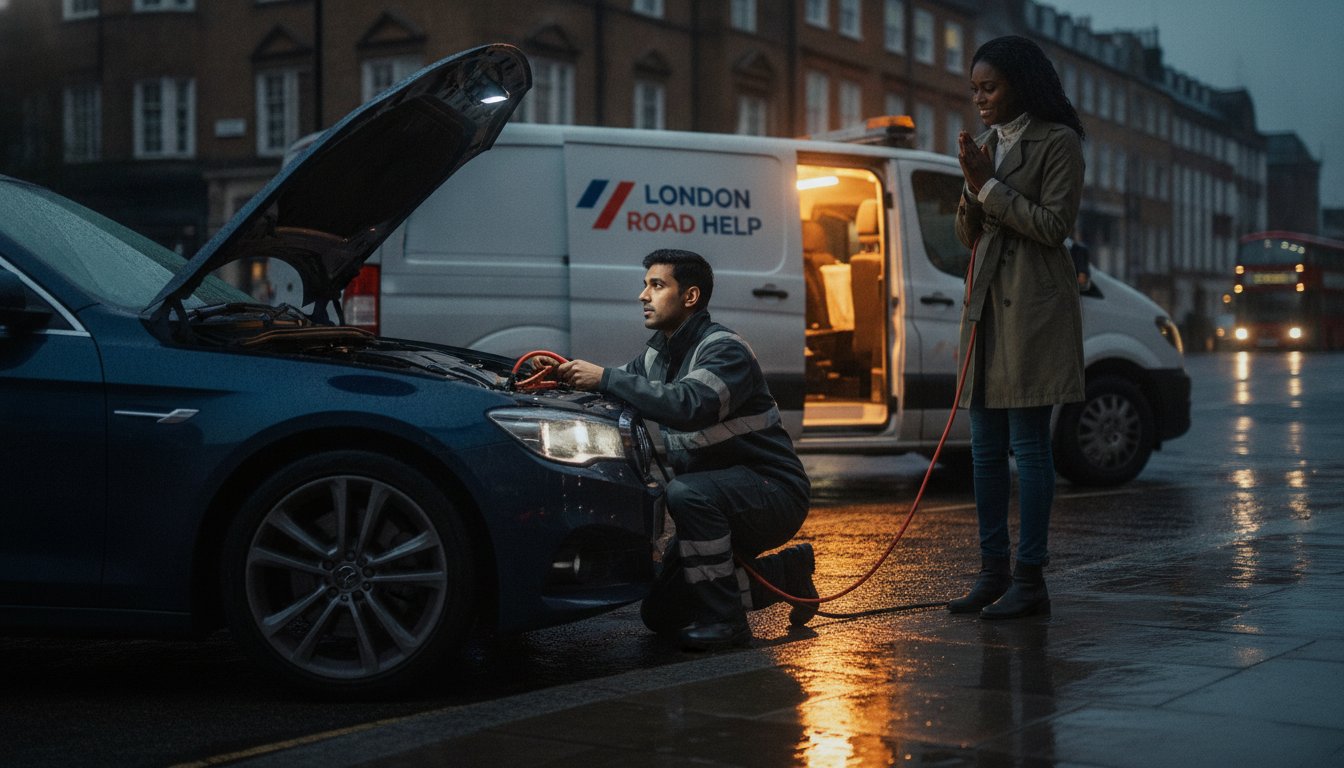
Did you know that drivers in London are almost twice as likely to face a breakdown compared to the rest of the country, with 66% of motorists experiencing a failure in their current vehicle? If you’re currently sitting in a cold car with a silent engine, you’re likely feeling that familiar surge of anxiety; it’s a high-stress situation that demands a calm and professional response. Whether you’re worried about being stranded in a dangerous location or concerned that a boost might fry your car’s modern electronics, finding a reliable emergency jump start London service is your top priority.
We understand that your vehicle is a vital part of your daily life, and we’re here to ensure it’s treated with the respect it deserves. Our promise is simple: we’ll help you get back on the road in under 40 minutes with a professional battery jump-start that protects your ECU from damage. In this guide, we’ll explore the safest methods for reviving a dead battery, how to avoid hidden call-out fees, and why a rapid, transparent service is the only way to handle a roadside crisis in the capital.
Key Takeaways
- Understand why stop-start traffic and short city commutes accelerate battery depletion and how to mitigate the unique “London Battery Drain.”
- Discover why choosing a professional emergency jump start London service is critical for protecting your car’s sensitive engine control unit (ECU) from dangerous voltage spikes.
- Learn the vital safety protocols to follow whilst waiting for assistance, ensuring you and your vehicle remain visible and safe on busy urban Red Routes.
- Find out how local knowledge of East London and Essex routes allows for rapid arrival times that bypass common traffic bottlenecks on the A12 and A13.
- Recognise the benefits of transparent, flat-rate pricing models that provide a reliable and affordable alternative to expensive full-recovery tows.
Why Flat Batteries Happen: The London Driving Factor
A flat battery rarely happens at a convenient time; it usually occurs exactly when you’re already running late for a meeting or trying to get home after a long shift. Understanding the mechanics of your vehicle can help lower that initial spike of stress. By definition, how a jump start works involves connecting a depleted battery to an external power source, such as a portable booster pack or another vehicle, to provide enough cranking amps to turn the engine over. In our busy capital, needing an emergency jump start London is often the result of “London Battery Drain,” a specific set of circumstances unique to urban driving that places immense pressure on your vehicle’s electrical system.
Lead-acid batteries rely on chemical reactions that are incredibly sensitive to the environment. Cold British winters are notorious for this, as low temperatures can cause a battery to lose up to 60% of its starting power. However, humid summers also play a role by accelerating internal corrosion and fluid evaporation. Before a total breakdown occurs, your car might give you subtle warnings, such as a sluggish engine crank when you turn the key, flickering dashboard lights, or a “check engine” symbol that appears without a clear mechanical cause.
Short Journeys vs Alternator Health
Most London commutes average around 15 to 20 minutes of stop-start traffic. This duration is often insufficient for the alternator to fully replenish the energy used to start the engine in the first place. When you factor in the heavy use of modern electronics like heated seats, dash cams, and satellite navigation, the battery remains in a constant state of semi-discharge. Parasitic drain in modern urban vehicles refers to the continuous power draw from security systems and on-board computers that slowly saps energy whilst the car is parked centrally in a driveway or on the street.
When a Jump Start is Only the First Step
Whether you’ve left your lights on or your car has been sitting idle for a week, a jump start is frequently the quickest way to get moving. However, it’s important to distinguish between a simple flat battery and a more serious mechanical failure. If your car starts but the engine dies again minutes later, or if you hear a clicking sound without the engine turning, the issue might lie with a faulty alternator or a worn starter motor. Professional diagnostics can identify these underlying problems on the spot, preventing the frustration of a second breakdown just ten minutes down the road. For more advice on staying safe during a breakdown, you can read our guide on Emergency Roadside Assistance in London.
Professional Jump Start vs DIY: Protecting Your Car’s Electronics
When your car refuses to start in the middle of a busy London street, the temptation to flag down a passing motorist for a quick boost is understandably high. Whilst well-intentioned, this “slave” starting method carries significant risks for modern vehicles. Today’s cars are essentially sophisticated computers on wheels, and a simple mistake with traditional jumper cables can lead to damaging your car’s electronics beyond repair. This is why a professional emergency jump start London service provides more than just a battery boost; it offers the security of knowing your Engine Control Unit (ECU) is safe from high-voltage surges.
Cheap, domestic jump leads found in petrol stations are often inadequate for the task. They are frequently made of thin, copper-clad aluminium that can struggle to carry the high current required, especially for diesel engines or larger SUVs. In some cases, these leads can even melt under high load, posing a fire risk or causing burns. Furthermore, if a DIY attempt goes wrong and fries a delicate sensor or the ECU, most insurance providers will view this as an “unauthorised repair,” leaving you with a repair bill that could reach thousands of pounds. Choosing to connect with a professional team ensures that the person handling your vehicle is fully insured and technically proficient.
Risks of Improper Cable Connection
The primary danger during a DIY jump start is the “surge” effect. When the cables are disconnected, a massive voltage spike can travel through the electrical system, instantly frying delicate sensors. This risk is even higher for hybrid and electric vehicles, which require specialised jump-start protocols to avoid damaging the high-voltage inverter systems. If you’re driving a modern eco-friendly car, you can find more specific advice in our Electric Vehicle Recovery London guide.
Professional Equipment Benefits
Our technicians use commercial-grade jump packs equipped with internal anti-surge protection. These devices provide a steady, regulated flow of power that mimics a healthy battery, protecting your car’s software. Before we even attempt a start, we test your battery’s “Cold Cranking Amps” (CCA) on-site. This diagnostic step tells us whether the battery is simply flat or if it has reached the end of its life and is no longer capable of holding a charge. We make sure your car is actually safe to drive before you pull away into London traffic.
Emergency Assistance Across East London and Essex
Whether you’re starting your morning in a quiet residential street in Stratford or find yourself stranded in a dimly lit car park in Dagenham after a late shift, the feeling of vulnerability is the same. We’ve dedicated our service to providing an emergency jump start London drivers can rely on 24/7. Our team knows that speed is a matter of safety as much as convenience. By positioning our dispatch hubs strategically, we ensure that help is never more than a short drive away, regardless of the time or weather conditions. We don’t just see ourselves as a service provider; we act as a “Caring Guardian” for motorists facing the stress of a non-starting vehicle.
Navigating the A12, A13, and the North Circular requires more than just a standard sat-nav; it requires genuine local knowledge. We understand the specific traffic patterns of East London, which allows our technicians to bypass common bottlenecks and reach you faster than national recovery chains might. This expertise is what allows us to maintain rapid response times whilst ensuring our vehicles are parked safely to protect you and your car from passing urban traffic. We take pride in our ability to find you quickly, even in the complex layouts of modern housing estates or industrial zones.
East London Response Zones
Barking and Dagenham serve as our central hubs for dispatch, allowing our teams to reach Newham and Redbridge within minutes of your call. Our local technicians are deeply familiar with the layout of Havering, ensuring we can locate your vehicle even in poorly marked areas. If a jump start isn’t enough to solve the underlying issue, we also offer comprehensive Car Breakdown Recovery East London to transport your vehicle to a safe location or a trusted garage.
Essex Border Coverage
Our support extends well into the Essex border, providing a lifeline to drivers in Romford, Brentwood, and the surrounding commuter towns. We adopt a “Reliable Neighbour” approach, treating every Essex call-out with the same urgency and care we’d show to someone in our own street. For most Essex-based emergency calls, we aim to have a professional technician by your side in under 40 minutes to get your day back on track. This commitment to punctuality and local presence means you aren’t left waiting on a hard shoulder or in a cold car for hours on end.
Safety Protocol: What to Do Whilst Waiting for Help
When your car fails in the heart of the city, your immediate priority shifts from the engine to your personal safety. Busy urban roads are unpredictable, and staying visible is the best way to protect yourself whilst waiting for an emergency jump start London. It’s easy to feel overwhelmed by the noise and traffic, but following a set protocol can keep you calm and secure until our technician arrives. Whether you are on a quiet side street or a major arterial road, your behaviour in these first few minutes is crucial. We act as your “Caring Guardian” from the moment you call, but your on-site actions ensure we can assist you safely and efficiently.
5 Steps to Stay Safe in a London Breakdown
- Step 1: Activate your hazard lights immediately. If it is dark, foggy, or visibility is poor, keep your sidelights on as well to ensure other drivers see your vehicle from a distance.
- Step 2: If you are on a dual carriageway or a busy A-road, exit the vehicle via the nearside (left) door. Never exit into the flow of traffic, as the risk from passing vehicles is too great.
- Step 3: Put on a high-visibility vest if you have one in your boot. Move away from the car and stand behind a safety barrier or on the verge, well clear of the road surface.
- Step 4: Use the “What3Words” app to identify your precise location. This digital tool gives our team a three-metre square location, which is vital on long stretches of the North Circular or in large industrial estates.
- Step 5: Keep your mobile phone line clear. Our technician may need to call you for final directions or to provide an updated arrival time as they navigate through local traffic.
Dealing with Red Routes and Clearways
London’s Red Routes are strictly monitored by cameras and enforcement officers to keep the city moving. If your battery fails in a restricted zone or a bus lane, the pressure to move can be intense. We understand the rules for disabled vehicles in these areas and can offer advice on how to communicate with local authorities if your car is causing a significant obstruction. Staying with your vehicle, provided it is safe to do so, is often necessary to explain the situation to traffic wardens and avoid unwanted towing by the council. If you find yourself in a vulnerable position on a busy route, contact our emergency team immediately for rapid, professional support that prioritises your safety.
Instant Recovery: Your Reliable Choice for Jump Starts
Choosing a recovery service in a moment of crisis shouldn’t feel like a gamble. At Instant Recovery, we operate with a “Caring Guardian” philosophy, which means we treat your vehicle with the same respect and attention we’d give our own. Whether you’re driving a compact city car or a long-wheelbase Transit van, our fully equipped service vehicles are ready to handle the job. We believe in total transparency, providing flat-rate estimates that ensure you won’t face any hidden “London surcharges” when the work is done. Our goal is to provide an emergency jump start London motorists can trust for its integrity as much as its speed.
A simple boost is often just a temporary fix if the underlying cause isn’t addressed. That’s why our team goes beyond the basic jump start to perform a quick charging system check. We test your alternator and battery health on-site to ensure the problem won’t re-occur the next time you turn the key. This methodical approach provides peace of mind, moving you away from a stressful breakdown toward a permanent resolution. It’s this commitment to thorough, professional care that distinguishes us as a premier emergency jump start London service, ensuring we don’t just get you moving, but keep you moving.
Why Barking and East London Drivers Trust Us
Our roots in Barking and the wider East London area have earned us a reputation as a “Reliable Neighbour.” We understand that car trouble doesn’t keep office hours, which is why our 24/7 availability includes bank holidays and even Christmas Day. We keep you informed at every stage of the process, from the moment our dispatcher takes your call to the second our technician arrives at your side. This clear communication helps lower the anxiety of the situation, letting you know exactly when help will arrive and what to expect.
Booking Your Emergency Assistance
Getting help is a straightforward and hassle-free process designed to save you time. You can receive a free, accurate estimate over the phone in seconds, allowing you to make an informed decision without any pressure. For your convenience, we accept various payment methods on-site, including card payments and digital transfers. If you’re currently stranded or simply want the security of a professional battery check, Contact Instant Recovery for a 24/7 Jump Start and let our team get you back on the road safely.
Get Back on the Move with Confidence
A flat battery in the middle of a busy city is more than a mechanical failure; it’s a disruption to your day that requires a calm and professional resolution. We’ve explored how the unique pressures of urban driving can deplete your battery and why using professional anti-surge equipment is vital for protecting your car’s modern electronics. By following the correct safety protocols and choosing a service with deep local knowledge of East London and Essex, you can transform a stressful breakdown into a manageable situation.
Whether you’re facing a silent engine at dawn or find yourself stranded after dark, our 24/7 rapid response team is ready to act as your reliable neighbour. We provide transparent local pricing with no hidden surprises, ensuring you receive the high-integrity care you deserve. Don’t let a depleted battery ruin your schedule. Get a Fast Emergency Jump Start in London Now and let our experts handle the rest. You’ll be back on the road before you know it, with the peace of mind that your vehicle is in safe, professional hands.
Frequently Asked Questions
Can I jump-start a modern car with a neighbour’s help?
While it is possible to jump-start a modern vehicle with a neighbour’s help, it is generally discouraged due to the risk of voltage spikes damaging sensitive Engine Control Units (ECUs). Professional services use anti-surge jump packs that regulate the flow of electricity, providing a safer alternative to traditional car-to-car starting. This protection ensures your vehicle’s sophisticated electronics remain safe throughout the process.
How long does a professional jump start take once the technician arrives?
A professional jump start typically takes between 10 and 15 minutes once the technician is on-site. This time includes performing a rapid diagnostic check of your battery’s health and the alternator’s charging rate to ensure the vehicle is safe to drive. Our goal is to get you moving quickly whilst verifying that the engine won’t simply fail again a few miles down the road.
Will a jump start fix a battery that has been flat for months?
A jump start is often ineffective if a battery has been left completely flat for several months, as the internal plates may have suffered from permanent sulfation. In these cases, the battery often loses its ability to hold a charge even after a successful start. If your vehicle has been sitting idle for a long period, our technicians can assess whether a boost will suffice or if a full replacement is required.
What happens if my car won’t start even after a jump-start attempt?
If your car fails to start after a professional jump-start attempt, the underlying issue likely involves the starter motor, alternator, or fuel system. Whether you are at home or on the roadside, we can immediately transition to a vehicle recovery service to assist you. We’ll ensure you and your vehicle are transported safely to a local garage for a more detailed mechanical inspection.
Are jump-start services available for vans and commercial vehicles in London?
Yes, we provide an emergency jump start London service for a wide range of commercial vehicles, including larger vans like the Ford Transit or Mercedes Sprinter. Commercial batteries require significantly higher cranking amps than standard cars, so we use heavy-duty, professional power packs designed to turn over these larger diesel engines. This ensures that tradespeople and delivery drivers can get back to their schedules with minimal delay.
Is it safe to jump-start my car in the rain?
It is perfectly safe to jump-start a car in the rain, provided the correct safety procedures are followed and professional equipment is used. The 12-volt system in a standard vehicle does not pose a risk of electric shock to the user in wet conditions. Our technicians take extra care to keep the battery terminals and connection points as dry as possible to ensure a solid electrical contact whilst working in the rain.
How much does an emergency jump start cost in London?
Do I need to drive the car for a long time after it has been jump-started?
You should drive your car for at least 30 to 60 minutes immediately after it has been jump-started to allow the alternator to recharge the battery. If you only perform a short trip or turn the engine off too soon, the battery may not have gained enough energy to restart the vehicle again. We recommend a steady drive on an A-road or motorway to ensure the charging process is as efficient as possible.