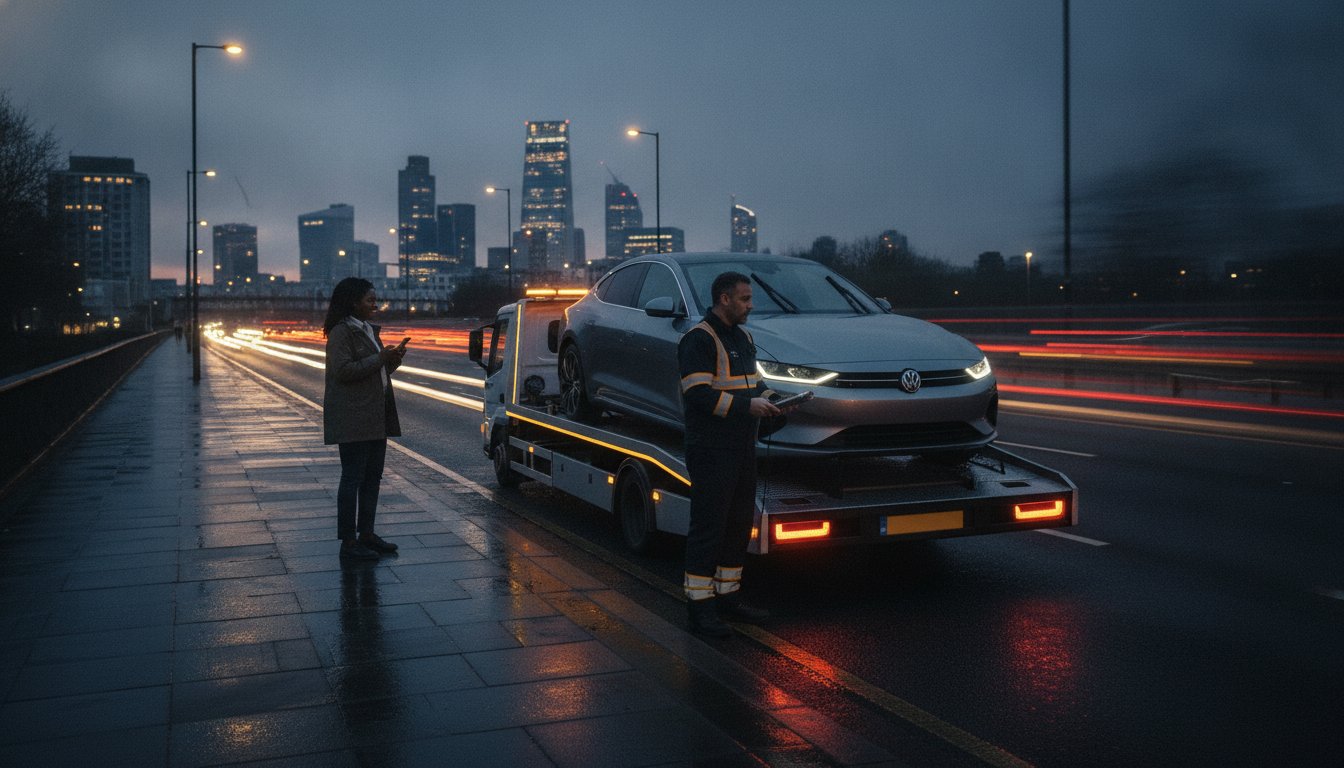
Imagine you’re heading home through East London when your engine suddenly cuts out on the A13, leaving you stranded amongst heavy traffic with no clear way out. Whether you’re facing a breakdown on a busy dual carriageway or a flat tyre on a quiet side street, the immediate feeling of vulnerability is something every driver understands. When you need emergency vehicle towing London services, you aren’t just looking for a lift; you’re looking for a professional who treats your car with the same care they would their own.
We know that the confusion over different types of recovery equipment and the fear of further damage can make a difficult situation feel even more overwhelming. This comprehensive guide will help you understand the professional recovery process from start to finish, ensuring you make the right choice during a breakdown. You’ll discover the specific equipment used for modern vehicles, learn how to stay safe whilst waiting for help, and find out how to identify a reliable local provider in East London who prioritises your safety and peace of mind.
Key Takeaways
- Understand how professional flatbeds and spec-lift vehicles provide damage-free transport, tailored to the specific environment of your breakdown.
- Learn the “get out and stay out” rule and other critical safety steps to keep your passengers protected whilst waiting for help on London’s busy A-roads.
- Familiarise yourself with the 2026 legal standards for emergency vehicle towing London to ensure your recovery is compliant and safe.
- Discover why choosing a provider with local knowledge of East London and Essex traffic patterns is the key to a faster, more efficient recovery.
- Gain the confidence to identify trustworthy services that provide transparent pricing and professional care for your vehicle during high-stress situations.
What are Towing Services and Why are They Essential?
Professional towing is the safe recovery and transport of disabled vehicles by trained experts. It’s much more than just moving a car from one point to another; it’s a specialised safety service designed to protect your vehicle and the people around it. In a city as densely populated as London, a single stalled car on a major route can lead to miles of congestion. Professional recovery teams play a vital role in maintaining the city’s traffic flow and preventing secondary collisions on high-speed roads.
Whether you’re driving a modern electric SUV or a traditional petrol hatchback, today’s cars are incredibly complex machines. You can’t simply hook them up to a friend’s car with a rope and hope for the best. Advanced sensors, automatic transmissions, and delicate suspension systems require modern towing equipment to ensure your property isn’t damaged during transport. Choosing professional emergency vehicle towing London services means trusting experts who understand these technical nuances and treat your car with the care it deserves.
The Difference Between Roadside Repair and Recovery
Sometimes, a quick fix is all you need to get back on your way. We often help drivers with on-site solutions such as a jumpstart or an emergency tyre change. However, roadside assistance has its limits. If your vehicle has suffered significant accident damage or a total mechanical failure, recovery becomes the only safe option. A professional team will assess your situation immediately to decide the best course of action. They’ll determine if your car can be safely mobilised on the spot or if it requires a full lift to a garage or your home.
When Do You Actually Need a Tow?
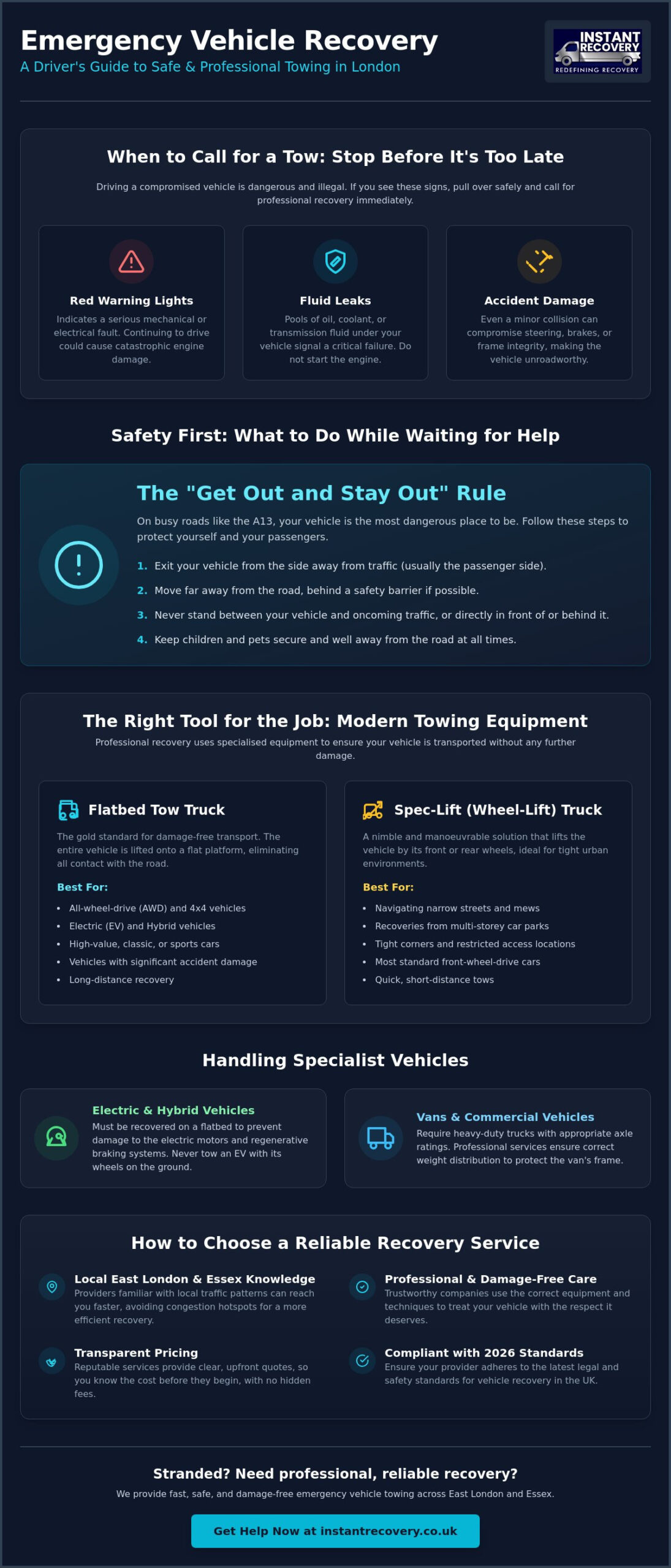
It’s often tempting to try and “limp” home when your car feels wrong, but this is rarely a good idea. If you see a red warning light on your dashboard or notice fluid leaking onto the tarmac, you should stop as soon as it’s safe to do so. Driving a compromised vehicle in heavy London traffic increases the risk of a total breakdown in a dangerous location, such as a yellow box junction. Beyond the physical risks, there are serious legal implications. Driving an unroadworthy vehicle on UK public roads can lead to fines and points on your licence. When your car isn’t fit for the road, calling for emergency vehicle towing London is the most responsible choice you can make for yourself and other road users.
The Anatomy of Modern Towing Equipment
When you call for emergency vehicle towing London, the equipment that arrives on the scene is just as important as the person operating it. Professional recovery isn’t a one-size-fits-all solution. Flatbed tow trucks are widely considered the gold standard for damage-free transport because they carry the entire vehicle off the ground. This eliminates any wear on the transmission or drivetrain, which is particularly vital for long-distance recovery or high-value cars. Winching and snatch blocks are also essential tools in our arsenal. They allow us to retrieve vehicles from awkward positions, such as steep ditches or tight corners, with surgical precision and total control.
However, London’s unique geography often demands more nimble solutions. For those stranded in narrow mews or multi-storey car parks with restrictive height limits, spec-lift (wheel-lift) vehicles are the ideal choice. These trucks are much shorter and more manoeuvrable than flatbeds. By lifting only one set of wheels, they can navigate tight urban environments where larger recovery vehicles simply wouldn’t fit. Whether you’re in a spacious car park or a cramped side street, the right equipment ensures your car is moved safely without risk to its bodywork.
Specialist Towing for Vans and Larger Vehicles
Standard tow trucks often lack the capacity to handle high-roof or long-wheelbase vans. Professional van recovery London requires heavy-duty equipment with specific axle ratings to manage the increased weight. We pay close attention to weight distribution to ensure the van’s frame isn’t stressed during transport. This level of care is essential for commercial fleets where keeping the vehicle in peak condition is a business necessity.
Safeguarding Electric and Hybrid Vehicles
Electric vehicles (EVs) present a technical challenge that traditional towing methods can’t solve. You shouldn’t tow an EV with the wheels on the road, as the spinning motors can damage the regenerative braking system or cause overheating. This is why electric vehicle recovery London almost always necessitates a flatbed. Our teams are trained to monitor battery safety and thermal stability throughout the loading process to protect your car’s most sensitive components.
Damage-Free Techniques: Protecting Your Investment
Protecting your vehicle’s undercarriage and bumpers is our top priority. We use soft straps rather than metal chains and secure the car using manufacturer-approved tie-down points on the chassis. This meticulous approach is central to our philosophy of damage free car towing London. Every recovery we perform adheres strictly to the UK Towing Regulations, ensuring your vehicle is transported legally and securely. If you find yourself in a difficult spot, you can contact our team to discuss the best equipment for your specific situation.
Staying Safe Whilst Waiting for Recovery
Breaking down on a route like the A12 or the M25 is a frightening experience. The noise and speed of passing traffic can feel overwhelming, but your priority must remain the safety of yourself and your passengers. If you’re on a motorway, you should follow the “Get Out and Stay Out” rule. This means exiting the vehicle through the passenger-side doors, furthest from the traffic, and moving well behind the crash barrier or up an embankment. We understand how vulnerable you feel in these moments, and our team is trained to reach you as quickly as possible to restore your sense of security.
Whether you are waiting on the hard shoulder of a motorway or a busy dual carriageway, following the official guidance for Staying Safe Whilst Waiting for Recovery is your first priority. Once you have moved to a safe position, contact us for emergency vehicle towing London. To help us find you amongst the city’s complex road network, try to provide your exact location using the what3words app or by identifying the nearest landmark or motorway marker post. When our driver arrives, they will clearly identify themselves and confirm your details before starting the hook-up process, ensuring you feel protected throughout the encounter.
Positioning Your Vehicle for Safety
If your vehicle is still on the road, turn on your hazard lights immediately. In low-visibility conditions, such as London’s frequent fog or heavy rain, keeping your sidelights on is also essential. Whilst warning triangles are useful on quiet roads, you should never use them on a motorway as the risk of being hit whilst placing them is too high. If you’ve managed to pull onto the hard shoulder or a verge, turn your steering wheel away from the road. This simple action ensures that if your car is struck from behind, it’s pushed away from traffic rather than into it.
Preparing Your Vehicle for the Tow
Before our recovery truck arrives, take a moment to gather your essentials. Make sure you have your phone, keys, wallet, and any necessary medication with you. Ensure the handbrake is firmly engaged and, if requested by our operator, place the vehicle in the correct gear for transport. If you’re facing engine failure or accident damage, providing clear information about the fault helps our operator prepare the right equipment for your emergency vehicle towing London. We’re here to handle the heavy lifting, so you can focus on staying calm and safe until we arrive.
UK Towing Regulations and Driver Responsibilities
If you’re considering asking a friend to tow your car with a rope, it’s vital to understand the legal risks involved in 2026. UK road laws have become increasingly strict regarding vehicle recovery to ensure the safety of all road users. Attempting a DIY tow with a simple rope or pole isn’t just dangerous; it can lead to heavy fines and points on your licence if the setup doesn’t meet specific lighting and braking requirements. When you choose professional emergency vehicle towing London, you’re ensuring that your vehicle is moved in full compliance with the law, protecting both your driving record and your car’s mechanical integrity.
Professional recovery operators must adhere to rigorous DVSA standards and maintenance protocols. This includes regular safety audits of the recovery fleet and ensuring every driver is trained in the latest securement techniques. Whether you’re dealing with a minor breakdown or a complex accident recovery, these regulations exist to prevent secondary incidents on busy routes like the A13. It’s also worth checking your insurance policy before a tow begins. Many comprehensive policies cover the cost of professional recovery, but they may refuse to pay out if you’ve allowed an unlicensed “cowboy” operator to handle your vehicle.
Towing Capacity and Weight Limits
Understanding Gross Train Weight (GTW) is a critical part of a recovery operator’s job. This is the total allowable weight of the recovery truck plus the vehicle it’s carrying. As of 2026, drivers with a standard Category B licence can tow trailers with a Maximum Authorised Mass (MAM) of up to 3,500kg, but professional recovery often involves much heavier loads. We calculate these weights meticulously before dispatching a truck to your location. Exceeding these limits is a serious legal offence that can result in the vehicle being impounded and the driver facing prosecution. By ensuring the recovery vehicle is perfectly matched to your car’s weight, we maintain total control and safety on the road.
Licensing and Professional Standards
The 2026 UK market demands high qualifications for recovery experts. Professional operators must demonstrate technical proficiency and a commitment to ethical service. At Instant Recovery, we pride ourselves on being a high-integrity helper that goes beyond the basic requirements. We follow strict safety audits to ensure every lift is performed with precision. Choosing a verified professional over an uncertified provider protects your vehicle from frame stress and ensures your insurance claim remains valid. If you need a team that prioritises legal compliance and vehicle care, you can book our professional recovery services to get home safely.
Choosing a Reliable Towing Company in London and Essex
When you’re stuck on the side of the A406 or caught in a bottleneck near the Blackwall Tunnel, you don’t just need a truck; you need a partner with deep local knowledge. Navigating the unique traffic patterns of East London and Essex requires an operator who understands the shortcuts and congestion zones that can delay a recovery. Choosing a provider for emergency vehicle towing London should be based on their ability to reach you quickly and their commitment to keeping you informed. You deserve a team that provides regular updates on their arrival time, helping to ease the anxiety of being stranded in a busy or unfamiliar location.
Transparency is another critical factor when you’re in a high-stress situation. Many drivers worry about hidden fees or sudden surcharges being added to their bill once the vehicle is already hooked up. A reliable company will always provide a clear, upfront explanation of their charges; for instance, you can explore per-incident towing and roadside assistance fees options to see how professional services structure their rates. Whether you are in a quiet Essex suburb or the middle of a London red route, the pricing should be honest and easy to understand. By combining 24/7 availability with a focus on integrity, a professional recovery service acts as a safety net for the local driving community.
What to Look for in a Recovery Partner
Before you make a call, take a moment to check for verified reviews and professional accreditation. A trustworthy partner will have a diverse fleet of equipment, ensuring they can handle everything from low-profile cars to heavy commercial vehicles. It’s also worth assessing their response times in specific areas like Barking or the London Outer area. For more detailed advice on vetting your options, you can refer to our guide on finding a towing company in the local region.
The Instant Recovery Approach: Professionalism and Care
Our “Caring Guardian” philosophy ensures that your vehicle is treated with absolute respect from the moment we arrive. We believe that professional recovery is about more than just transport; it’s about providing a supportive presence when you’re facing a difficult day. We’re proud to offer clear, upfront car recovery cost London estimates so you can make an informed decision without any pressure. If you require immediate assistance in Barking, Romford, or Stratford, our team is ready to help. When you need emergency vehicle towing London, you can count on us to be the reliable neighbour who gets you and your vehicle home safely.
Secure Your Journey with Professional Support
You now have the knowledge to handle a breakdown with confidence. From understanding the technical necessity of flatbed transport for EVs to following the “Get Out and Stay Out” rule on the motorway, you are better prepared for the unexpected. Choosing the right partner for emergency vehicle towing London ensures your car is treated with respect whilst you stay safe. Professional recovery is about more than just moving a vehicle; it’s about restoring your peace of mind when things go wrong on the road.
Whether you are facing a flat tyre in Barking or a mechanical failure on the A12, our team is ready to help. We provide a 24/7 emergency response across London and Essex, using professional, damage-free equipment operated by a highly-rated local team. Our deep road knowledge means we reach you quickly, providing the calm support you need in a crisis. Don’t let a breakdown leave you stranded. Get a Free Towing Estimate from Instant Recovery and let us take care of the heavy lifting for you. We’re here to help you get back on track safely and efficiently.
Frequently Asked Questions
Can I tow my own car with a rope in the UK?
While it’s technically legal to tow a car with a rope for very short distances in an emergency, it’s highly discouraged for modern vehicles in 2026. Without the engine running, your power steering and servo-assisted brakes won’t function, making the car incredibly difficult to control. Professional emergency vehicle towing London is much safer, as it prevents damage to your bumpers and protects your transmission from unnecessary wear.
How much do towing services typically cost in London?
The cost of vehicle recovery depends on the distance of the journey and the complexity of the situation. We believe in providing transparent pricing and offer free estimates before we dispatch a driver to your location. Factors such as the time of day, the size of your vehicle, and the need for specialist equipment like a flatbed will influence the final rate for your recovery.
Is it safe to tow an electric vehicle (EV)?
Standard towing can cause severe damage to an electric vehicle’s motor and battery system because of how regenerative braking functions. Most manufacturers mandate that EVs are transported on a flatbed trailer so that all four wheels remain off the ground. It’s essential to let us know if you’re driving an electric or hybrid car so we can send the correct equipment to protect your investment.
How long will it take for a tow truck to arrive in East London?
Arrival times depend on traffic conditions and your specific location, but we aim to reach drivers in East London and Essex within 40 to 60 minutes. We prioritise your safety and will provide regular updates on our progress whilst you wait in a secure spot. Our local team knows the area’s bottlenecks well, which helps us navigate to you as efficiently as possible.
Do towing services operate 24/7?
Yes, professional recovery teams operate 24 hours a day, 365 days a year. We know that breakdowns don’t follow a schedule, so we’re always on standby to help. This model of 24-hour towing and roadside assistance provided by specialists like Dependable Towing & Recovery Services is a global standard for motorist safety. Whether you’re facing a 3 am engine failure or a rush-hour accident in Stratford, we’re ready to provide emergency vehicle towing London whenever you need it most, regardless of the time.
Will my insurance cover the cost of towing?
Many comprehensive insurance policies include breakdown or recovery cover, but it’s important to check your specific policy details. If you don’t have cover, you can still use our services on a pay-on-use basis. This is often more reliable than waiting for a generic insurance contractor, as you’ll have a direct line to the professional team coming to your assistance.
What information do I need to provide when calling for a tow?
When you call, please provide your exact location, your vehicle’s make and model, and a brief description of the fault. We also need to know if the vehicle can still roll and steer. This information allows us to dispatch the right recovery truck for the job, such as a spec-lift for tight spaces or a flatbed for an electric car.
Can a towing service recover my car from a multi-storey car park?
We can recover vehicles from multi-storey car parks, though this requires specialist equipment. Standard flatbed trucks are usually too tall for the low ceilings found in many London car parks. In these situations, we use a low-profile spec-lift vehicle designed to navigate restricted-height environments and safely extract your car without risking damage to the roof or bodywork.