
A flat tyre doesn’t wait for a convenient moment. It strikes on the A13 during rush hour, on a dark slip road in Barking, or halfway through a school run in Ilford, and suddenly you’re stranded somewhere unfamiliar, wondering who on earth you can actually trust to help. If you’re searching for an emergency tyre change East London right now, you’re probably feeling that exact mix of stress, uncertainty, and urgency. That’s completely understandable.
You already know you need help fast. What you’re less sure about is whether the person who shows up will charge you a fair price, handle your vehicle with care, and actually get you moving again without unnecessary delays or hidden fees. Those are entirely reasonable things to want to know before you make a call.
This guide is here to give you clarity. Whether you’re facing a blowout on a busy dual carriageway or a slow puncture that’s left you stuck in a side street, you’ll find everything you need to make a confident, informed decision quickly. We’ll walk you through what to do in those first critical minutes, what professional roadside assistance looks like, and how to get safe, transparent help across East London without the worry.
Key Takeaways
- Your physical safety always comes first — this guide reveals the exact steps to take in those critical first moments after a puncture on East London’s busiest roads, including the A12 and A13.
- Knowing how to read your tyre sidewall means you can communicate your requirements clearly and avoid being overcharged or fitted with the wrong tyre in an emergency tyre change East London situation.
- Not every tyre incident calls for the same solution — you’ll learn how to assess the damage yourself and determine whether a mobile fitting or full vehicle recovery is the right call.
- Local knowledge of East London’s road network, from Blackwall Tunnel congestion to the layout of areas like Shoreditch and Romford, plays a significant role in how quickly help can reach you.
- Transparent, flat-rate estimates and a commitment to honest service mean you can secure professional roadside assistance without worrying about hidden costs or unwelcome surprises.
Staying Safe After a Puncture in East London
Before you think about the tyre, think about yourself. That’s the single most important principle to carry with you in any roadside emergency. A tyre is replaceable. You are not. Whether you’ve felt that sickening lurch on the A13 near Dagenham or heard the rhythmic thudding of a slow puncture on the North Circular, your first instinct might be to pull over immediately and assess the damage. That instinct is correct, but how you do it matters enormously.
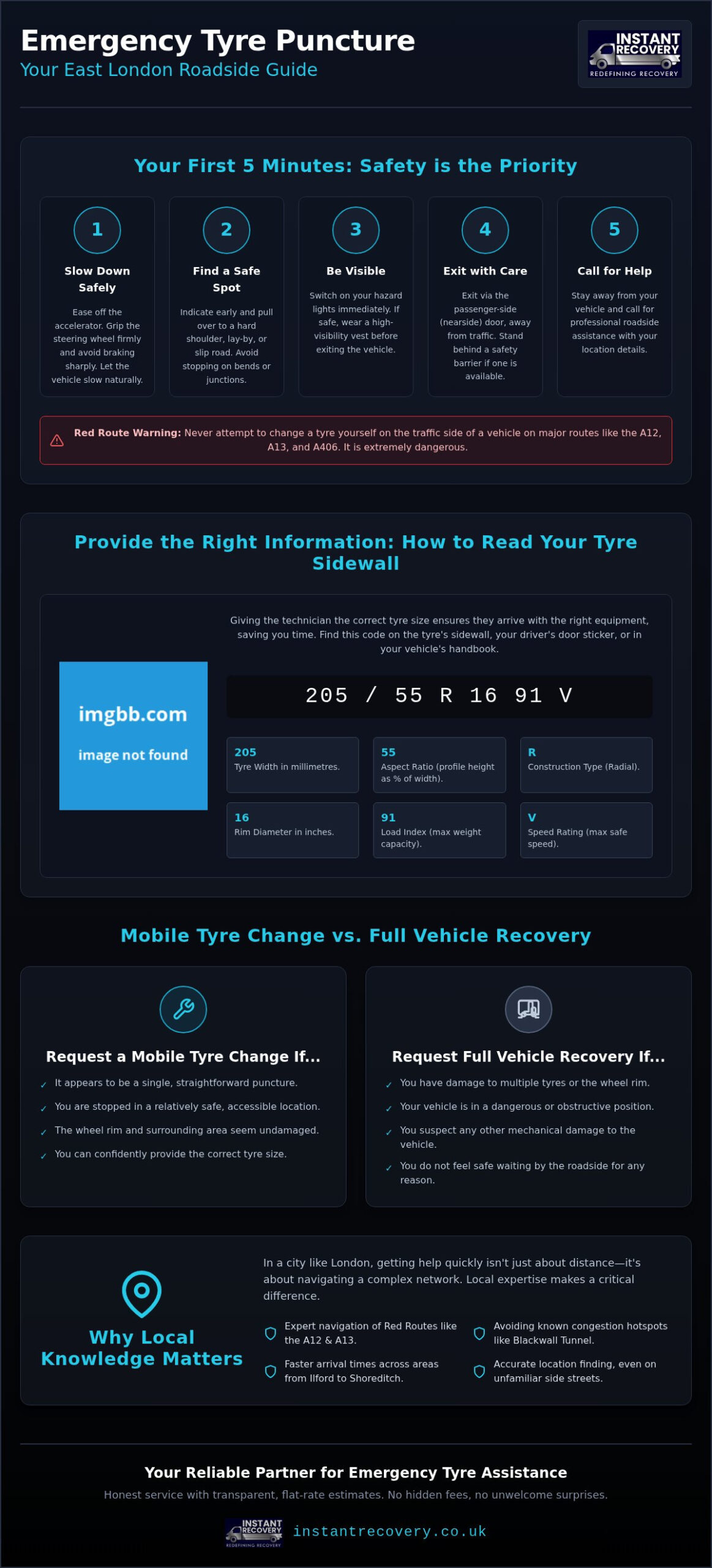
Don’t brake sharply. Ease off the accelerator gradually, grip the steering wheel firmly with both hands, and allow the vehicle to slow naturally. Indicate early and look for the nearest safe stopping point, which on a dual carriageway means a hard shoulder, a slip road exit, or a lay-by. Avoid stopping on the apex of a bend or immediately before a junction where visibility is reduced. If you’re on the A12 approaching the Bow interchange, for instance, getting past that junction before stopping is worth the extra few seconds of careful driving on a damaged tyre. Understanding the broader context of tyre types and construction can help you appreciate why a controlled stop protects both your rim and your safety.
Safety Protocols for London Red Routes
East London’s red routes, including significant stretches of the A13, A12, and A406, carry some of the highest traffic volumes in the capital. Stopping on these roads carries real risk. Once you’ve pulled over as far left as possible, switch on your hazard lights immediately and, if you have one, put on a high-visibility vest before you open the door. Never attempt a DIY tyre change on the offside of the vehicle on a red route. The traffic side is not a safe working environment under any circumstances. If you feel the vehicle is dangerously exposed, exit from the nearside door, move behind the safety barrier, and wait there. Your priority is distance from moving traffic, not proximity to the problem. For an emergency tyre change East London situation on a red route, calling for professional assistance is always the right call.
Communicating Your Precise Location
When you call for help, a clear location saves critical minutes. East London offers some genuinely useful landmarks: the ArcelorMittal Orbit in Stratford, the distinctive slopes of the Beckton Alps near the A13, or the Canary Wharf tower cluster visible from much of the Isle of Dogs. If you’re on a complex junction or an unfamiliar stretch of road, the What3Words app divides the entire world into three-metre squares, each with a unique three-word address, and it works even with limited signal. If your battery is critically low, describe the road number, your direction of travel, and the last junction or exit you passed. That combination gives any dispatcher enough to locate you quickly and get the right help moving in your direction.
Identifying Your Requirements: Tyre Sizes and Roadside Logistics
Once you’re safely stopped and your hazard lights are on, the next thing a roadside technician will need from you is information. Specifically, your tyre size. Knowing how to read that string of numbers and letters off your sidewall takes about thirty seconds, and it could be the difference between a technician arriving with exactly the right tyre or having to make a second trip. It’s a small piece of knowledge that pays dividends precisely when you’re least in the mood to learn something new.
How to Find Your Tyre Size in 30 Seconds
The tyre size string, for example 205/55 R16, tells you the tyre’s width in millimetres (205), the profile as a percentage of that width (55), and the rim diameter in inches (16). You’ll find it moulded into the sidewall in raised lettering. If the tyre is muddy or the markings are worn, check the door pillar sticker on the driver’s side or your vehicle handbook, both of which list the manufacturer’s recommended specifications. Don’t guess; fitting the wrong size creates handling problems that are genuinely dangerous on East London’s busier roads.
Two further markings matter more than most drivers realise: the load rating and the speed rating. The load rating is a numerical index that tells you the maximum weight each tyre can safely support. The speed rating is a letter, typically found immediately after the rim size, denoting the tyre’s maximum safe operating speed. In London driving conditions, where stop-start traffic on the A13 is followed by faster stretches on the M25, fitting a tyre with an inadequate speed rating is both a safety risk and a potential insurance issue. The UK Highway Code vehicle maintenance and tyre safety guidance is clear that tyres must be suitable for the vehicle’s use. A professional technician will always match these ratings, not just the diameter.
The Locking Wheel Nut Dilemma
Almost every modern car sold in the UK comes fitted with at least one locking wheel nut per wheel, a security measure designed to deter theft. It requires a uniquely keyed socket to remove, and without it, no wheel change is possible. Full stop. The key is usually stored in the glovebox, the boot tool kit, or tucked beneath the boot floor panel alongside the spare. Find it now, before you need it.
If it’s lost, don’t panic, but do mention it immediately when you call for help. Specialist extraction tools exist that can remove locking wheel nuts without the key, though this takes additional time and may not be possible in every roadside situation. In some cases, vehicle recovery becomes the more practical route. For a straightforward emergency tyre change East London to proceed smoothly, that small key matters enormously, so it’s genuinely worth locating it on a calm afternoon rather than a stressful one.
One further distinction worth understanding is whether your vehicle is fitted with run-flat tyres. These have reinforced sidewalls that allow limited driving, typically around 50 miles at reduced speed, after a puncture. They cannot be repaired in the same way as standard tyres and must be replaced rather than patched. If you’re unsure which type you have, your vehicle handbook will confirm it. Knowing this before you call means the technician can come prepared, saving everyone time. If you’d like guidance on which recovery option suits your specific situation, speaking with a local roadside specialist is always a sensible first step.
Emergency Tyre Change vs. Full Recovery: Making the Right Call
Not every roadside tyre incident is the same, and treating them as though they are can lead to wasted time, unnecessary expense, or worse, an unsafe vehicle back on the road. The first and most important judgement you’ll need to make, or that a professional will make on your behalf, is whether you’re dealing with a straightforward puncture or something more serious. Getting that distinction right shapes everything that follows.
A mobile tyre fitting van is the ideal solution in many situations. If you’ve picked up a nail or screw in the tread, the tyre has deflated gradually rather than catastrophically, and the wheel itself is undamaged, a trained technician can arrive at your location, fit a replacement tyre, and have you moving again without any need to tow the vehicle. It’s efficient, it’s contained, and it resolves the problem exactly where you’re standing. That’s the best-case scenario for an emergency tyre change East London call-out, and it’s the outcome most drivers are hoping for.
Roadside Repair Criteria
Whether a tyre can be repaired or must be replaced entirely depends on three factors: where the damage is, how large it is, and the tyre’s overall condition. Punctures in the central three-quarters of the tread may be eligible for a plug repair, but any damage to the sidewall makes the tyre structurally compromised and irreparable. Full stop. The sidewall flexes constantly under load, and a patched sidewall will not hold. Reputable technicians follow industry repair standards that limit plug repairs to punctures no larger than 6mm in diameter; anything beyond that requires a full replacement. The UK Highway Code tyre safety guidance is clear that tyres must be free from structural damage before a vehicle is driven. Before you rejoin the carriageway, a professional will also check tyre pressure, inspect the valve, and confirm the wheel nuts are correctly torqued.
When Recovery is the Only Safe Option
Some situations go beyond what a mobile fitting van can resolve. East London’s roads, particularly the A13 and its surrounding industrial approach roads, are notorious for surface debris and pothole damage. Hitting a deep pothole at speed doesn’t just destroy the tyre; it can crack an alloy wheel, bend a rim, or cause suspension and steering damage that isn’t immediately visible. Driving away on a freshly fitted tyre without addressing underlying damage is genuinely dangerous.
Recovery is also the right call when:
- Multiple tyres have blown simultaneously, which can happen after hitting significant debris at speed.
- The wheel itself is cracked or buckled and cannot safely seat a new tyre.
- The vehicle is pulling sharply or the steering feels abnormal after the incident, suggesting possible suspension impact.
- The tyre has been driven on whilst flat, damaging the rim beyond roadside repair.
This is precisely where choosing a service that offers both options matters. Many tyre fitting operators can only do one thing: fit tyres. If your situation falls outside that narrow scope, you’re left making a second call to a separate recovery company, losing valuable time whilst standing at the roadside. Instant Recovery carries the capability to assess your situation and, if a tyre change isn’t feasible, move directly to vehicle recovery and transport your car to a specialist garage for proper inspection. One call, one team, and a clear path forward regardless of what the damage turns out to be. That’s the kind of joined-up response that genuinely reduces stress when you’re already having a difficult day.
Navigating East London’s Road Network: Why Local Knowledge Matters
There’s a significant difference between a service that lists East London postcodes on a website and one that actually knows this patch of the city. Knowing that the Blackwall Tunnel’s northbound bore closes periodically for maintenance, that the A13 near Ripple Lane backs up long before rush hour officially begins, or that a van coming from central London will hit the Bow flyover queue before it gets anywhere near Barking: that kind of operational intelligence is what separates a fast response from a frustratingly slow one. Local knowledge isn’t a marketing phrase here. It’s the reason a genuinely local team gets to you sooner.
Instant Recovery is based in East London, which means the team navigating towards you already understands the road network rather than relying entirely on a sat-nav that doesn’t account for local congestion patterns. When the Blackwall Tunnel is causing its predictable tailback, an experienced local dispatcher knows to route via the A13 or the Rotherhithe Tunnel depending on where you are. That kind of real-time, experience-driven decision-making compresses arrival times in ways that a city-wide conglomerate dispatching from a distant depot simply cannot replicate.
ULEZ expansion and the ongoing evolution of London’s road schemes also affect recovery logistics in practical ways. Older recovery vehicles that don’t meet the current ULEZ emission standards face daily charges for operating within the zone, costs that some operators quietly absorb into their pricing. A locally based team operating compliant vehicles doesn’t carry that overhead, which is one reason transparent, flat-rate estimates remain genuinely achievable.
Response Times in East London Hotspots
Stratford, Canning Town, and Leyton sit within a relatively compact triangle, but traffic behaviour within that triangle varies enormously depending on the time of day and the state of the Stratford gyratory. For an emergency tyre change East London call from any of these areas, a locally based team can often use established alternative routes through Plaistow and Maryland that bypass the worst of the congestion. East London doesn’t sleep either. Dalston at 3 AM, the Newham industrial estates during a night shift changeover, the A12 before dawn: these are real scenarios, and a service that’s genuinely available around the clock is prepared for all of them.
Area-Specific Challenges
Narrow residential streets in Hackney present a practical challenge that a large recovery truck simply can’t navigate. A mobile tyre fitting van with a smaller footprint can reach spots that heavier vehicles can’t. Near the M11 and A406 junction, where speeds are higher and verges are tighter, safe positioning of the response vehicle matters enormously. In the quieter industrial stretches of Newham, where a stranded driver can feel genuinely isolated late at night, a calm, friendly voice on the phone followed by a prompt arrival makes an enormous difference to how manageable the situation feels.
Whether you’re stuck on a residential backstreet in Hackney or exposed on a slip road near Romford, local expertise is what closes the gap between calling for help and actually receiving it. Contact the Instant Recovery team for a free estimate and fast dispatch across East London.
Instant Recovery: Your Reliable Partner for Emergency Tyre Assistance
Being stranded at the roadside is stressful enough without having to wonder whether the person coming to help you is trustworthy. That uncertainty is something Instant Recovery was built to eliminate. Think of the team less as a faceless service provider and more as a reliable neighbour who happens to have exactly the right skills and equipment: someone who picks up the phone, gives you a straight answer, and actually shows up when they say they will.
Transparent pricing is a core part of that commitment. Before anyone sets off towards you, you’ll receive a clear, flat-rate estimate covering the work required. No hidden call-out fees. No ambiguous extras that appear on the invoice after the job is done. Whether your situation calls for an emergency tyre change East London or a full vehicle recovery, you’ll know what to expect financially before you agree to anything. That kind of honesty matters enormously when you’re already having a difficult day.
The equipment used reflects the same care. Proper torque wrenches ensure wheel nuts are tightened to the correct specification rather than guessed at. Alloy-friendly tools protect your wheels during removal and refitting. Every step of the process is carried out with the same attention you’d want someone to give your own vehicle, because that’s the standard the team holds themselves to.
There’s also the human side of this work, which deserves acknowledgement. A breakdown is rarely just an inconvenience. It can feel frightening, isolating, and overwhelming, particularly late at night or in an unfamiliar part of the city. Instant Recovery’s team understands that. A calm, reassuring voice on the phone and a technician who takes a moment to explain what they’re doing and why can genuinely transform the experience from something distressing into something manageable.
The Instant Recovery Difference
Every car is treated with the same care the team would want for their own. The 24/7 dispatch across East London and Essex means that whether you’re stuck in Barking at noon or on a quiet Ilford backstreet at 2 AM, help is available. Crucially, the dual capability of tyre fitting and full vehicle recovery means you’re never left in a situation where one service can’t help and you’re forced to start again with a second call.
How to Book Your Emergency Assistance
The booking process is straightforward by design. When you call, the team will ask for your location, your vehicle make and model, and a brief description of what’s happened. If you’ve already found your tyre size, that’s useful too. From there, you’ll receive a free estimate and a confirmed dispatch. Real-time updates mean you’ll know your technician is on the way and roughly when to expect them, so you’re never left watching the road in silence and wondering.
Call Instant Recovery now for a fast, free estimate on your emergency tyre change East London.
Get Moving Again with Confidence
A flat tyre in East London doesn’t have to derail your day. The key things to carry with you from this guide are straightforward: prioritise your safety before anything else, know your tyre size so help can arrive prepared, and understand that not every incident is a simple swap. Sometimes a full recovery is the smarter, safer choice.
What makes the difference in those stressful roadside moments is having a team that’s genuinely local, available around the clock, and honest about what the job involves before any work begins. Whether you need a swift emergency tyre change East London or your vehicle needs towing to a specialist, having one number to call and one team to rely on removes an enormous amount of uncertainty from an already difficult situation.
You don’t have to figure this out alone. Professional, empathetic help is available 24/7 across East London, with full towing capacity if a roadside fix isn’t possible. Get an immediate quote for your emergency tyre change in East London and let a team that genuinely cares get you safely back on the road.
Frequently Asked Questions About Emergency Tyre Changes in East London
How much does an emergency tyre change cost in East London?
The cost depends on your tyre size, the type of tyre required, and whether your situation calls for a straightforward roadside fitting or something more complex. Rather than quoting a figure that may not reflect your specific circumstances, Instant Recovery provides a free, flat-rate estimate before any work begins. You’ll know exactly what you’re agreeing to before the technician sets off, with no hidden call-out fees added afterwards.
How long will I have to wait for a mobile tyre technician to arrive?
Response times vary depending on your precise location, the time of day, and current traffic conditions across East London’s road network. Being locally based means the team can make informed routing decisions rather than relying solely on sat-nav, which genuinely helps during peak congestion periods. When you call, you’ll receive a realistic arrival estimate and real-time updates so you’re never left waiting in silence wondering what’s happening.
Do you carry spare tyres for all car makes and models?
The team carries a broad range of tyres to cover the most common sizes across popular vehicles, but stock naturally varies. This is why knowing your tyre size before you call makes a real difference. Sharing the three-number code from your sidewall, for example 205/55 R16, along with the load and speed ratings, allows the technician to confirm availability and arrive properly prepared, avoiding any unnecessary delays at the roadside.
What happens if you can’t change my tyre at the roadside?
If a roadside fix isn’t feasible, whether because of wheel damage, suspension concerns, or a tyre that’s been driven flat, the team moves directly to vehicle recovery. Your car is transported to a specialist garage for proper inspection rather than leaving you stranded or pressuring you into an unsafe repair. Having both capabilities under one roof means one call resolves the situation regardless of what the damage turns out to be.
Can you change a tyre if I’ve lost my locking wheel nut key?
It’s worth mentioning this immediately when you call, because a missing locking wheel nut key does complicate matters. Specialist extraction tools can remove locking wheel nuts without the key in many cases, though this takes additional time and isn’t always possible at the roadside depending on the nut type and condition. In some situations, vehicle recovery becomes the more practical and safer route forward. Being upfront about it from the start helps the team arrive prepared.
Is it safe to wait in my car while you change the tyre on a busy road?
On exposed roads like the A13 or A12, waiting outside the vehicle is generally not advisable, but remaining inside carries its own risks if the car is poorly positioned. The safest approach is usually to exit from the nearside door, move behind any available safety barrier, and wait at a distance from moving traffic. Your technician will advise you on the safest arrangement for your specific location once they assess the scene on arrival.
Do you provide emergency tyre services for vans and commercial vehicles?
Yes. Whether you’re driving a private car or a commercial van, the team can assist. It’s helpful to mention your vehicle type when you call, as vans often require different tyre sizes and may have higher load rating requirements than standard passenger cars. Providing your vehicle’s make, model, and tyre size upfront ensures the technician arrives with the right equipment and appropriate tyres for the job.
Are your technicians available on Bank Holidays and weekends?
Instant Recovery operates 24 hours a day, seven days a week across East London and Essex, including Bank Holidays. A puncture doesn’t observe public holidays, and neither does the service. Whether you need an emergency tyre change East London on a Sunday evening or during the Christmas period, the team is reachable and ready to dispatch. Simply call to confirm availability and receive your free estimate before anything else is agreed.